185 insurer-state records, 145 companies across 30 states, ranked by the share of in-network claims they denied. These are insurance denial rates as the companies themselves reported them, not a list somebody assembled. National average: 18.7%. The last column is the one that should be bigger.
Source: CMS Transparency in Coverage Public Use File (PY2026 release, PY2024 claims), data.healthcare.gov — US Government public domain.
51 insurer-state records that appeared in earlier releases are not in the plan-year 2026 file, because those insurers moved off the federal Exchange platform. Their old URLs redirect to the state page for the market they were in, which carries current figures; none of them is counted in the 185 above.
Work out your two deadlines
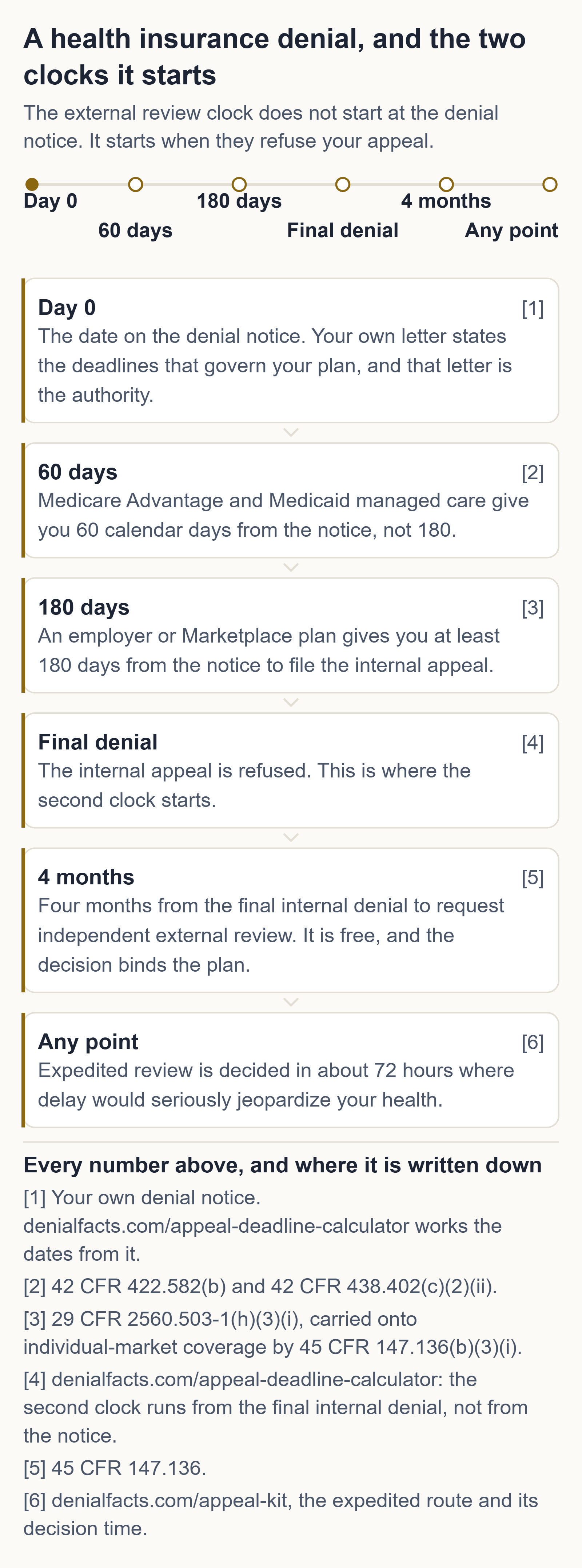
The federal timeframes: 180 days from the date on the denial notice to file the internal appeal, then 4 months from the final internal denial to request independent external review. Put your date in and get the actual calendar dates, with the days remaining.
Runs entirely in your browser, the date you type is never sent to us and never stored. Open the full calculator →
What this ranking means for your own denial, and by when. Across the 185 insurer-state records ranked above, 84,502,749 in-network claims were denied and 5,881 independent external reviews were filed, one for every 14,369 denials, and 32.8% of the reviews that were filed were overturned, the national rows in the plan-year 2026 release of the CMS Transparency in Coverage file, read September 5, 2026 (data.healthcare.gov). Whichever way that lands, nobody files the appeal for you, and the filing runs on a clock set by which plan you hold: an employer or Marketplace plan gives you at least 180 days from the denial notice to file the internal appeal (29 CFR 2560.503-1(h)(3)(i), carried onto individual-market coverage by 45 CFR 147.136(b)(3)(i)), while Medicare Advantage gives you 60 calendar days after you receive its notice (42 CFR 422.582(b)) and Medicaid managed care the same 60 calendar days from the date on the notice (42 CFR 438.402(c)(2)(ii)), both stages free, and the free calculator above turns the date on your letter into both of those windows, and the full free walkthrough is on how to appeal. The free steps are above; the $29 kit is the same clock with the letters pre-filled for whichever of these insurers denied you. One payment. No subscription. No cut of your claim.
This page is a list, and a list is a cold thing to land on when
you are holding a letter. So: find your insurer, open its page, and read the last column before you
read the first one, how many of its denials ever reached the independent stage. That is the number
that tells you whether the people around you were using the rights you have. If your insurer is not
here, the federal file simply does not report it, and your appeal rights are exactly the same. Write
to me if you cannot find yourself in this table and I will point you at the right page.
Denied a claim? Insurers upheld 66% of the internal appeals people filed in 2024 (KFF). The win is at independent external review, and the only way to arrive there is to run the internal stage on time, in the right order, with the record intact. That sequence is what the Appeal Kit is. Get my Appeal Kit, $29 One payment. No subscription. No cut of your claim. Opens on screen the moment you pay. 14-day refund, no questions, one email to hello@getaxionlabs.com.
Reading either regulation from a script rather than a browser: eCFR answers automated fetches with a challenge page, so the same two sections are mirrored as government PDFs at govinfo.gov (29 CFR 2560.503-1) and govinfo.gov (45 CFR 147.136).
This page presents federal statistics and a general description of appeal rights created by federal law. It is not legal, medical, or insurance advice, and no outcome is guaranteed. Your denial letter and plan documents govern your specific case. Free help is available from your state's Consumer Assistance Program and from the federal Marketplace at HealthCare.gov.
The external review clock does not start at the denial notice. It starts when they refuse your appeal.
Questions people ask
These are the questions Google shows people asking alongside this page, in the words they are asked in. Each one gets one sentence, from the same sources as the rest of the page.
What insurance company has the highest denial rate?
The top row of this table holds it, and the claim volume printed beside it is there so a high rate on a small book is not read as the same finding as a high rate on a large one.
What are the top 5 worst insurance companies?
The first five rows of the ranked table on this site answer that on one measure only, the share of in-network claims denied, which is the measure CMS collects and not a judgement of the company.
Which insurance companies approve the most claims?
Approval is the other side of the same column: sort this table the other way and the lowest denial rates are the highest approval rates, against a national 18.7%.
Which insurance company has the most customer complaints?
Complaint counts are held by state insurance departments rather than by the CMS file this table is built from, so we do not rank them; each state page here prints that department's own consumer route.
Which insurance company has the highest denial rate?
The same first row, and it is an insurer-state record rather than a national brand, because that is the level at which the file reports.
What percent of insurance claims are denied?
18.7% of in-network claims in the plan-year 2026 CMS Transparency in Coverage release, 84,502,749 of the claims insurers reported receiving.
What is a good claim denial rate?
There is no published standard to call good, so the only honest comparison is against the national 18.7% and against the other records in this table.
Which health insurance has the lowest denial rate?
The bottom of this ranked table holds it, and it is the same list read upwards rather than a separate ranking.
Thank you. That goes straight to the person who writes these pages.