Appeal letter sample: your health insurance appeal letter, free, with your two dates already in it
Three of these four are already answered if you came here from one of our insurer or state pages. Nothing you type is sent to us or stored, there is no form here that posts anywhere, and no third-party script on this page.
The three above refine the letter; the four in the box write it. Change any of them and a letter already on screen rewrites itself. If you want a reminder before your dates, that is a separate, optional box further down, and it stores two dates and an address and nothing else.
I have an MRI scheduled for Monday but the insurance called and told me the authorization for it was not approved. I don't know what else to do.
You do not need an account, an email address, or a card. Put in the date on your denial notice, who pays your claims, and the reason your letter gives. You get a finished appeal letter on this screen, with your internal-appeal deadline and your external-review deadline already written into it, and the federal rule behind each one cited so your plan can check it.
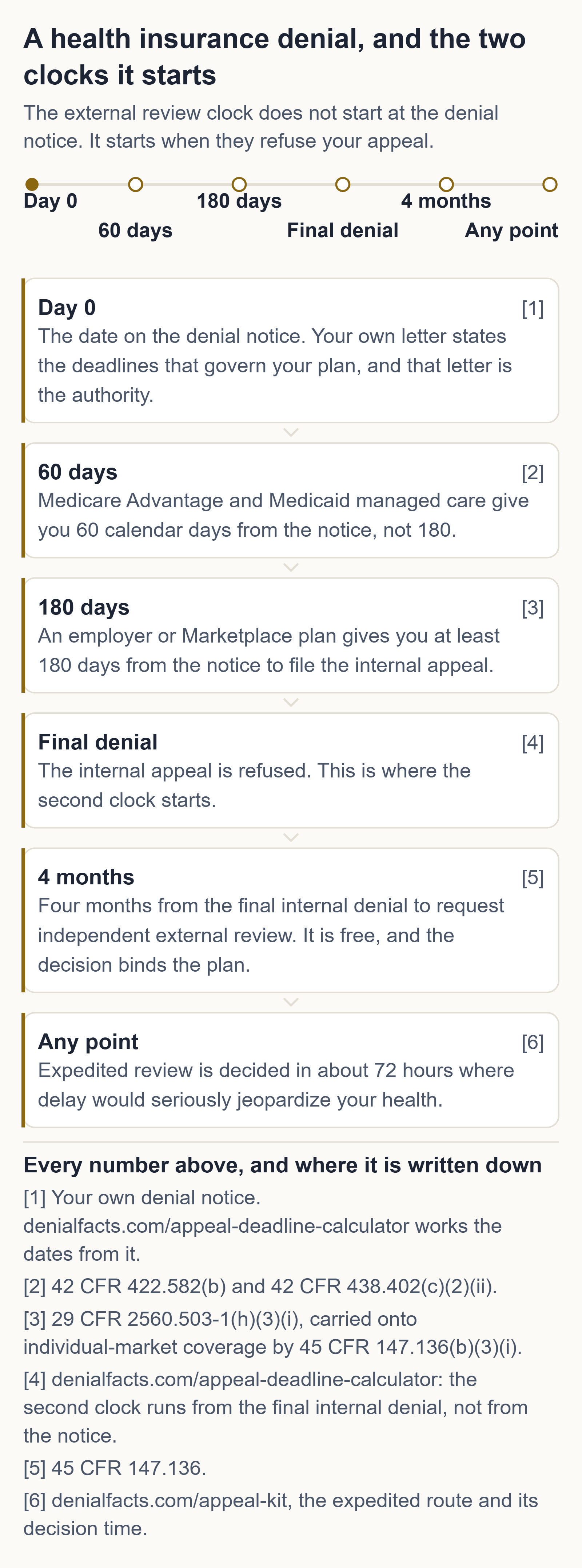
An appeal example, worked: what the sample above fills in for you
The four boxes are the whole sample. The date on your denial notice sets both deadlines; who pays your claims decides which federal rule the letter cites and which body hears you at the end; the state sets the external-review route; the reason picks the argument. Everything else in the letter, the citations, the document request, the sign-off, is written for you and does not change what you have to know. That is the difference between an appeal letter template you fill in yourself and an appeal example dated to your own case.
The three numbers in the box above, and where each one is from
| Figure | Value | What it counts |
|---|---|---|
| In-network claims denied | 84,502,749 | Across 185 issuer-state records in 30 states, plan-year 2026 release |
| Internal appeals filed | 263,021 | The free first stage, decided by the insurer that said no |
| Independent external reviews filed | 5,881 | 5,881 of 84,502,749, a rate of 1 per 14,369, the stage whose decision binds the plan |
| Of those, overturned | 32.8% | Nationally, in the same file |
Every one of those is CMS's own published figure, recomputed from the file rather than quoted from anybody's summary. We do not publish a success rate for appeals written with this generator, because we do not have one and we would have no way to get one honestly.
From the person who wrote it
I built this after reading the two regulations end to end. The argument is yours and I cannot improve it, but the date is the one part you cannot fix later, and it is the part the two regulations set out in the plainest terms. If you are stuck at midnight with the letter in front of you, write to me and I will point you at the right free route, even if that route is not ours., Andrew at Axion Labs, hello@getaxionlabs.com
What this letter does, and what it does not
- It dates your appeal correctly. The 180 days run from the date on the notice, not the day you opened it.
- It asks for the file. The single most useful paragraph in it is the one requesting the documents, records and criteria the decision was based on, you are entitled to them free, and of 84,502,749 denials only 263,021 were appealed at all, so the request is rarely made.
- It names the deadline your plan has to meet. When a plan blows its own answering deadline the rules can deem the internal process exhausted, which opens external review early.
- It does not make your argument for you. Nobody can write the clinical part of your appeal but you and your clinician, and a generator that pretends otherwise is selling you a form letter.
- It is not legal advice. We are not a law firm and nothing here is legal advice.
What happens after you print it
You sign it and you send it. That is the whole route, it is free, and it always will be. Send it the way your denial notice tells you to; the address and the fax number for appeals are printed on the notice itself, and that notice is the authority on which route your plan accepts. Keep a copy and proof of sending. Free help from a person is available from your state's Consumer Assistance Program and, for employer plans, the U.S. Department of Labor on 1-866-444-3272.
Is there a version where you post it for me?
Not today, and we would rather say so than take an order we cannot lawfully fill. A print-and-post step, where you sign the letter and we put your signed letter in the post, is under review by a US-licensed insurance-regulatory lawyer before it is offered anywhere, because in some states preparing or filing a claim for someone else for money is a licensed activity whatever the service calls itself. There is no price on it, no button, and no waiting list. When there is one, the five rules below will still be the rules.
We are not a law firm and nothing here is legal advice. We do not file appeals for anyone.
The five rules we hold ourselves to, in the words we wrote them in
These are lifted unchanged from our own build plan, because a rule that is softened for the public is not a rule. They govern any paid step on this site, including one that does not exist yet.
- The patient signs the letter, and the letter is sent in the patient's name. We never sign, we never write as them, and we never describe ourselves as acting on their behalf.
- The paid step is print-and-post of a patient-signed letter. It is fulfilment, not filing. No copy on any page may say “we file your appeal”, “we appeal for you”, or “we handle it”.
- Florida is geo-blocked for the paid step, and the paid step is never advertised into Florida, because §626.854 is not limited to property claims the way Delaware (18 Del. C. §1750/§1759(b)), California (Ins. Code §15007) and Texas (Ins. Code §4102.001) are.
- A signed authorisation from the patient is mandatory before anything is posted (
29 CFR 2560.503-1(b)(4); DOL Information Letter 27 Feb 2019;45 CFR 147.136; NAIC Model 75). There is no self-executing right to write to an insurer for someone else. - A US-licensed insurance-regulatory lawyer reviews the paid step before it launches, covering licensing and UPL as well as privacy. Desk research cannot close this and this plan does not pretend to.
Want one email before that date?
We store three things: your email address, that one calendar date, and which page you set it on. Not your name, not your claim, not your diagnosis, not the reason you picked, those never leave this device. The email carries a one-click link that deletes all three, and there is no list to be on: this is the only email it can ever produce. How that is kept.
Questions
Do I have to give you an email address?
No. There is no account, no email wall and no card on this page, and there is no locked version of the letter. The generator runs in your browser: nothing you type is sent to us or stored. The only place this site asks for an email is the optional reminder box, which stores two dates and an address and nothing else, and one click deletes both.
Is this letter enough on its own?
It is the frame, correctly dated, with the document request that goes with it. The part that decides a medical-necessity or experimental denial is the clinical argument, and that has to come from you and your clinician, which is why the letter leaves a marked space for it rather than inventing one. A letter that argued your case for you without knowing it would be a form letter.
Will you send it for me?
No. You sign it and you send it, using the address or fax number on your denial notice. We do not file appeals for anyone, we do not write to insurers as anyone, and we are not a law firm.
What if my deadline has already passed?
File anyway and say so. Plans can and do accept late appeals, the 180 days is a floor rather than a ceiling and some plans and states allow longer, and a refusal to hear a late appeal is itself something your state's Consumer Assistance Program can look at. The date on your own notice governs your plan; the generator computes the federal floor from it.
Which appeal system am I in?
The question the tool asks, who pays your claims, is the one that decides it, and it is the question no rival page we read asks. If your employer funds the plan itself, your state's external review has no power over your denial and the federal process does, however good your state's program is.
Counts: CMS Transparency in Coverage Public Use File (PY2026 release, PY2024 claims), data.healthcare.gov — US Government public domain. Rights and timeframes: 29 CFR 2560.503-1 (180 days, and your free right to the claim file) and 45 CFR 147.136 (4 months, and what qualifies), explained at HealthCare.gov. Expedited review is decided in about 72 hours under both sections.
Reading either regulation from a script rather than a browser: eCFR answers automated fetches with a challenge page, so the same two sections are mirrored as government PDFs at govinfo.gov (29 CFR 2560.503-1) and govinfo.gov (45 CFR 147.136).
Questions people ask
These are the questions Google shows people asking alongside this page, in the words they are asked in. Each one gets one sentence, from the same sources as the rest of the page.
How to write a good appeal letter?
Answer the reason your notice actually gives, in its own words, and attach what contradicts it, the generator above assembles that letter from your dates, and 29 CFR 2560.503-1(h)(2)(iii) entitles you, free of charge, to the claim file that tells you what you are answering.
What is a good example of an appeal?
The worked example on this page is the one we will stand behind: it quotes the insurer's stated ground back at it, names the plan provision it relies on, and asks for the documents the plan used to reach the decision.
How to write a letter to appeal against a decision?
Write to the appeals address printed on your own notice, say in the first line that you are requesting an internal appeal of that decision, and file inside the 180 days 29 CFR 2560.503-1(h)(3)(i) allows.
What is an example of appealing?
Appealing here means two free reviews, the internal one your plan must run when you ask, then an independent external review whose decision binds the plan (45 CFR 147.136), and of 84,502,749 in-network claims denied in the plan-year 2026 CMS Transparency in Coverage release, 263,021 reached an internal appeal and 5,881 reached external review.
What is a good appeal reason?
The reason that answers theirs: read the ground the notice states, then argue that ground and no other, which is why each of the nine grounds CMS collects has its own page here saying what to send.