Health insurance denial lawyer? Two free appeals come first, and a deadline
Put in the date on your denial notice. You get both federal deadlines as calendar dates, and the body that decides your case at the end.
Free, for a denial you are thinking of taking to a lawyer, and it runs entirely in your browser. The date, the plan type and the state you pick are never sent to us and never stored.
What surprised me was how fast everyone just moved on, the doctor suggested
We are not lawyers, we do not refer you to lawyers, and nobody pays us to send you anywhere. Here is the part a lawyer will tell you at the start of the meeting: federal law gives you an internal appeal and then an independent external review, both free, and on an employer or Marketplace plan a court will generally not hear you until you have used them. Running them yourself costs a stamp. Here are your two dates.
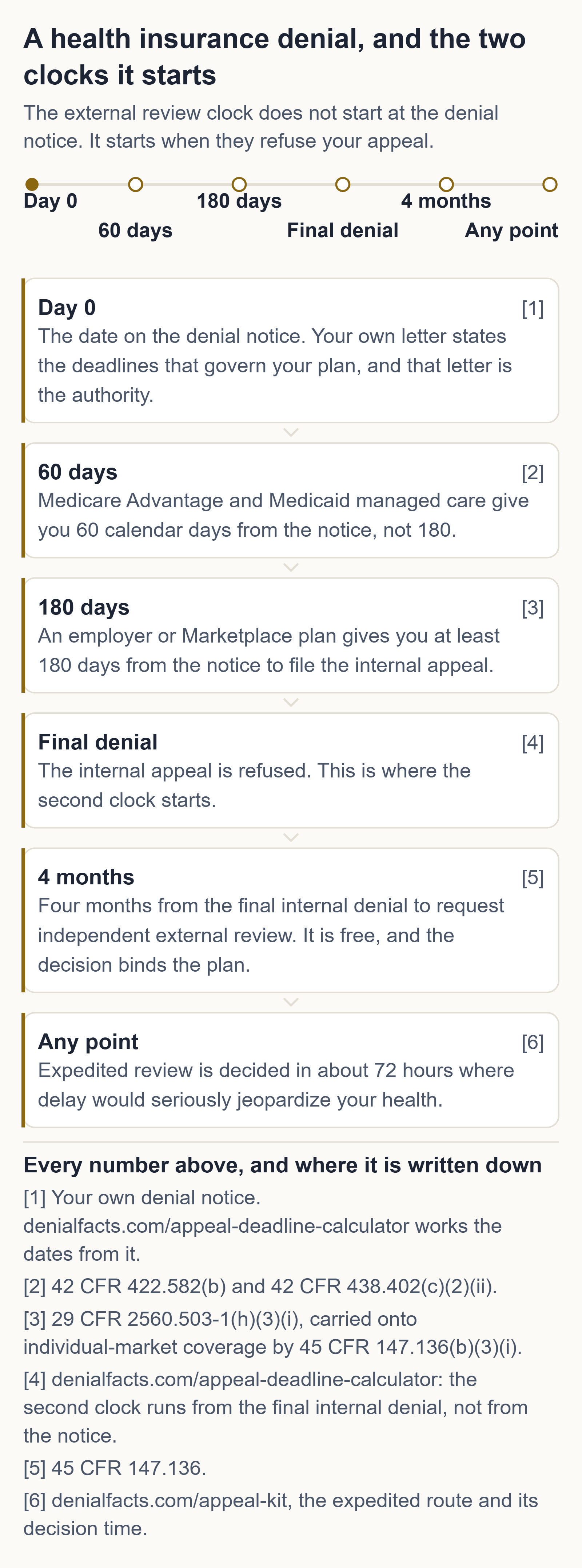
A lawyer cannot get either of these dates back for you once they have passed. You have 180 days from the date on your denial notice to file the internal appeal, and then 4 months from the final internal denial to ask for an independent external review. If waiting would seriously jeopardize your health you can ask for both to be expedited, decided in about 72 hours. Both timeframes are federal, not your insurer's choice, 29 CFR 2560.503-1 (PDF) and 45 CFR 147.136 (PDF), in plain English at HealthCare.gov, and your own denial letter states the ones that govern your plan. The PDFs are the same sections on govinfo.gov, which serves them without a challenge page, so an automated reader can check these two dates as easily as you can.
What a lawyer can and cannot add, stage by stage
This is the honest version, and it is not the same answer at every stage.
| Stage | What it costs you | What a lawyer adds here |
|---|---|---|
| Internal appeal, to the insurer, generally within 180 days of the notice | Free. A letter, and the claim file you are entitled to free of charge under 29 CFR 2560.503-1(h)(2)(iii) | Rarely the difference. The reviewer must be someone not involved in the first decision, and the argument that moves it is usually your doctor's, not a lawyer's |
| External review, independent, generally within four months of the final internal denial | Free under the HHS-administered federal process; any fee where a plan uses a contracted review organization is capped at $25 per review under 45 CFR 147.136 | Little. The reviewer is a clinician the plan does not control, the decision binds the plan by law, and the file is what decides it |
| After both are exhausted | This is where litigation starts | This is where a lawyer changes the answer. On an ERISA plan the court generally reviews the administrative record built during the appeals, which is why what you put in the two free stages is what a lawyer will have to work with later |
| Rescission, bad-faith conduct, or a plan ignoring its own deadlines | Not a paperwork problem | Talk to one. These are not the ordinary denial this site is about, and no free process substitutes for advice on them |
Exhaustion is the reason the order matters. On an employer plan governed by ERISA a court will generally expect you to have used the plan's own appeal process before it hears you, and the record you build in those free stages is generally the record the court reads. Appealing yourself first is not an alternative to legal advice: it is the step that has to happen anyway, and doing it well is what a lawyer would want you to have done.
The free humans, before anyone bills you
- Your state's consumer service. A free person whose job is to take your side. The published number for your state is on our state pages, each one read from the department's own site with the read date beside it.
- The U.S. Department of Labor, 1-866-444-3272, the free human for employer plans, and the office that enforces the claims rules your plan is running under.
- Your doctor's office. A peer-to-peer review is a call between your physician and the plan's reviewer, it is free, and it is the step most often skipped.
Questions
Do I need a lawyer to appeal a denied health insurance claim?
Not for the two federal stages. Both are designed to be used by the claimant: the internal appeal goes to someone at the plan who was not involved in the first decision, and the external review goes to an independent organization the plan does not control, whose decision binds the plan by law. Nationally 32.6% of internal appeals and 32.8% of external reviews were overturned for the people who filed them. Those are outcomes for filers, not a prediction about your claim, and we publish no success rate of our own because we have none.
Does appealing myself hurt my case if I need a lawyer later?
The opposite risk is the real one. On an ERISA plan a court generally reviews the administrative record built during the appeals, so the file you build in the free stages is usually what a lawyer inherits. What hurts a later case is a stage that was skipped or filed late, not a letter written without counsel. Ask for the complete claim file in writing at the start, 29 CFR 2560.503-1(h)(2)(iii) entitles you to it free of charge, and it is the document any lawyer would ask for first.
What does a health insurance denial lawyer usually cost?
We do not publish a figure, because we have not measured one and an invented number would be worse than none. What we can say is what the free route costs: nothing for the internal appeal, nothing for the federal external review, and a cap of $25 per review on any fee where a plan uses a contracted independent review organization, at 45 CFR 147.136. Ask any firm you call how their fee works, whether it is contingency or hourly, and what they would do that you cannot do yourself at the stage you are actually at.
When is a lawyer clearly worth it?
When the problem is not the paperwork. Rescission of coverage, a plan that ignores its own deadlines, a denial with money or employment consequences beyond the claim itself, or a case that has already exhausted both appeals and is heading to court. Also when you simply cannot face it, that is a real reason, and nobody should pretend otherwise.
Is there free legal help for a denied claim?
Often, yes. Your state's Consumer Assistance Program or insurance department consumer service is free and is staffed by people who do this all day. For an employer plan the U.S. Department of Labor's Employee Benefits Security Administration takes calls on 1-866-444-3272. Legal aid organizations and law school clinics in many states take health-coverage cases. None of them charges you, and none of them is us.
Two dates decide more of this than anything else, and neither is on the front of your letter in a way anyone notices. Work them out tonight, write them on the letter itself, and you have already done the part that is easiest to lose. If your dates are strange, a denial that arrived after the treatment, or a letter with no external-review instructions on it at all, send me the wording with the identifying details removed and I will tell you which clock you are on.
, Andrew at Axion Labs · hello@getaxionlabs.comWe are not a law firm and nothing here is legal advice. Free help from a person is available from your state Consumer Assistance Program and, for employer plans, the U.S. Department of Labor on 1-866-444-3272.
Show my two dates, freeNo account, no email, no card. Both federal deadlines dated from your notice, with the regulations cited, and a letter you sign and send yourself.
Counts: CMS Transparency in Coverage Public Use File (PY2026 release, PY2024 claims), data.healthcare.gov — US Government public domain. Rights and timeframes: 29 CFR 2560.503-1 (180 days, and your free right to the claim file) and 45 CFR 147.136 (4 months, and what qualifies), explained at HealthCare.gov. Expedited review is decided in about 72 hours under both sections.
Reading either regulation from a script rather than a browser: eCFR answers automated fetches with a challenge page, so the same two sections are mirrored as government PDFs at govinfo.gov (29 CFR 2560.503-1) and govinfo.gov (45 CFR 147.136).
Questions people ask
These are the questions Google shows people asking alongside this page, in the words they are asked in. Each one gets one sentence, from the same sources as the rest of the page.
Can you fight your health insurance denial?
Yes, twice, and both are free: an internal appeal with the insurer, then an independent external review whose decision the plan must obey (45 CFR 147.136).
What kind of lawyer deals with health insurance?
The two specialisms people mean are ERISA benefits litigation, for coverage through a job, and insurance bad-faith work, for an individual policy, and both begin after the two free reviews under 45 CFR 147.136 have been used, which is the whole argument of this page.
Which health insurance denies the most claims?
In the plan-year 2026 CMS Transparency in Coverage release insurers reported 84,502,749 in-network claims denied, a national rate of 18.7%; the ranking of who denied what share is on our ranked table rather than here.
What are the odds of winning an insurance appeal?
We publish what was recorded rather than a prediction: in the plan-year 2026 CMS Transparency in Coverage release 263,021 internal appeals produced 85,807 overturns and 5,881 external reviews produced 1,929, and neither figure describes any individual case.