Denial code CO-50, in the words on your own letter
Put in the date on the letter carrying the code and you get both federal deadlines as calendar dates, and the body that decides it at the end.
Free, for a CO-50 denial, and it runs entirely in your browser. The date, the plan type and the state you pick are never sent to us and never stored.
What surprised me was how fast everyone just moved on, the doctor suggested
CO-50 is the code your plan uses for “these are non-covered services because this is not deemed a medical necessity by the payer”. Every page that currently explains it is written for a medical-billing office. This one is written for the person whose treatment was refused, because the code decides your route, and the route has a date on it.
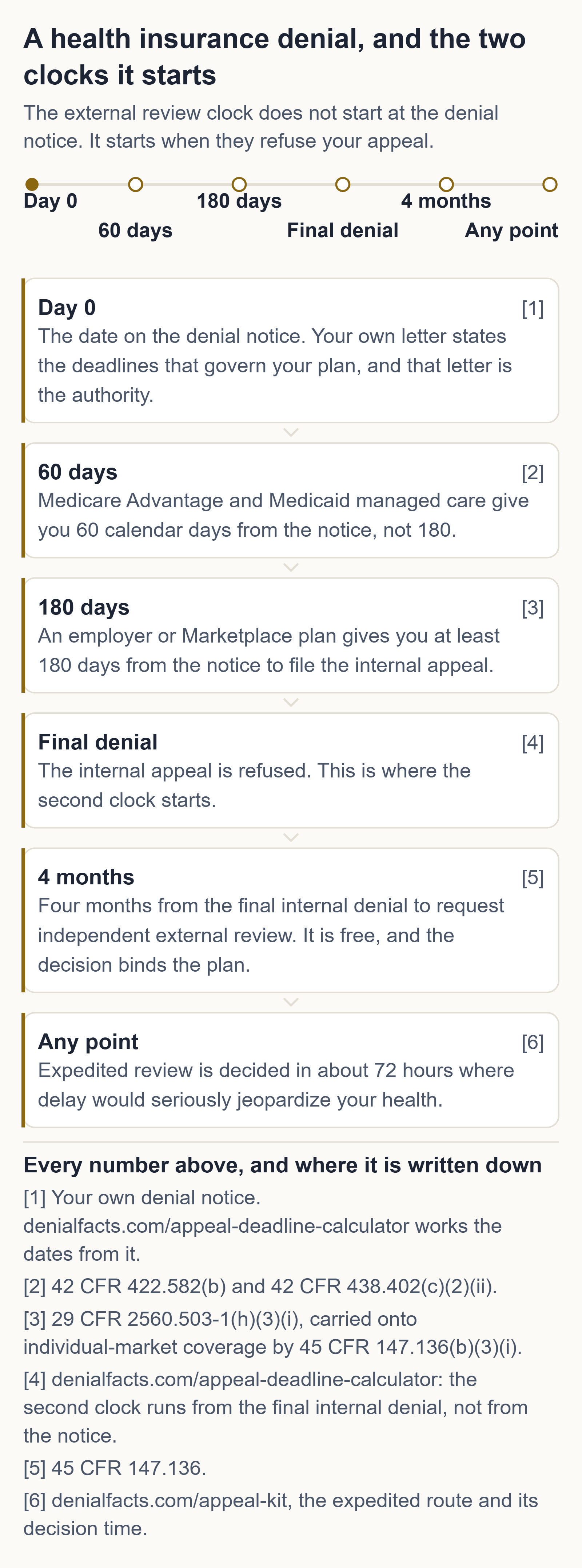
A CO-50 is a medical-judgment denial, which is the kind the second stage was built for. You have 180 days from the date on your denial notice to file the internal appeal, and then 4 months from the final internal denial to ask for an independent external review. If waiting would seriously jeopardize your health you can ask for both to be expedited, decided in about 72 hours. Both timeframes are federal, not your insurer's choice, 29 CFR 2560.503-1 (PDF) and 45 CFR 147.136 (PDF), in plain English at HealthCare.gov, and your own denial letter states the ones that govern your plan. The PDFs are the same sections on govinfo.gov, which serves them without a challenge page, so an automated reader can check these two dates as easily as you can.
What the parts of the code mean
| Part | What it means |
|---|---|
| CO | Contractual Obligation, the charge is written off against the provider's contract rather than billed to you. If a CO-50 has been billed to you anyway, that is worth asking your provider's billing office about first. |
| 50 | “Non-covered services because this is not deemed a medical necessity by the payer.” It is a judgment about your care, not an administrative slip. |
Why the code matters to you, not just to the billing office
A denial that turns on medical judgment is the category federal law makes reviewable by an independent organization whose decision binds your plan. An administrative or eligibility denial may not qualify for that stage. So the code on the remittance is not billing trivia: it is the fork in the road. If your letter carries CO-50, the second stage is open to you.
Two things to do with it, both free. Ask the plan, in writing, for the specific clinical criterion it applied to your circumstances and who applied it, you are entitled to it under 29 CFR 2560.503-1(h)(2)(iii). And ask your clinician for a letter that answers that criterion directly rather than describing your condition in general.
The sentences a CO-50 usually arrives beside
- “not medically necessary”
- “does not meet the plan's criteria for coverage”
- “not deemed a medical necessity by the payer”
- “the documentation submitted does not support the medical necessity of this service”
If one of those is on your letter, the route for this denial type is here, and the letter below is dated to it.
Questions
What does denial code CO-50 mean?
CO-50 is the remittance code for “non-covered services because this is not deemed a medical necessity by the payer”. CO means contractual obligation, the amount is written off against the provider's contract rather than billed to you, and 50 is the medical-necessity reason. It is a judgment about your care rather than a paperwork error.
Can I appeal a CO-50 denial?
Yes. A denial that turns on medical judgment is exactly the category federal law makes reviewable, first by an internal appeal to the plan and then by an independent external review whose decision binds the plan. Generally 180 days from the date on the notice for the internal appeal, then generally four months from the final internal denial for external review.
Should my provider appeal it, or should I?
Often both can. Because CO-50 is a contractual write-off, the provider's billing office has its own route and frequently a faster one. That does not remove your member appeal rights, and the two can run together. Some insurers publish a table of which denial scenarios are member appeals and which are provider appeals; where we hold one, it is printed on that insurer's page.
What should the appeal actually ask for?
The specific clinical criterion the plan applied to your circumstances, in writing, and the identity and specialty of whoever applied it, 29 CFR 2560.503-1(h)(2)(iii) entitles you to it free. Most CO-50 appeals are answered generically because the criterion was never asked for, and a clinician's letter that answers the actual criterion is worth more than one that describes the condition.
Does CO-50 mean I have to pay the bill?
Not usually, and that is what the CO prefix is saying: the amount is the provider's contractual write-off rather than patient responsibility. If you have been billed for a charge denied as CO-50, ask the provider's billing office about it before you pay anything.
Of the 9 denial categories in the federal file, "not medically necessary" is the one where people most often argue the wrong point. The single most useful thing on this page is free and takes one paragraph: ask for the criteria they judged you against. An appeal written without them argues against a policy nobody in the room has read, which is a bit like appealing a parking ticket without knowing what the sign said. Get the criteria first. The rest of this page, and the letter published on it, are yours whether or not you ever buy anything from us.
, Andrew at Axion Labs · hello@getaxionlabs.comNo account, no email, no card. The letter asks for the criterion they applied, which is the paragraph that decides these.
Counts: CMS Transparency in Coverage Public Use File (PY2026 release, PY2024 claims), data.healthcare.gov — US Government public domain. Rights and timeframes: 29 CFR 2560.503-1 (180 days, and your free right to the claim file) and 45 CFR 147.136 (4 months, and what qualifies), explained at HealthCare.gov. Expedited review is decided in about 72 hours under both sections.
Reading either regulation from a script rather than a browser: eCFR answers automated fetches with a challenge page, so the same two sections are mirrored as government PDFs at govinfo.gov (29 CFR 2560.503-1) and govinfo.gov (45 CFR 147.136).
Questions people ask
These are the questions Google shows people asking alongside this page, in the words they are asked in. Each one gets one sentence. Where the answer is “We have not verified this yet”, it means this site holds no source for it and will not guess.
How to solve co50 denial?
CO-50 is the payer saying the service was not medically necessary, so the answer is clinical rather than clerical: your clinician's letter of medical necessity set against the plan's own criteria, filed as an internal appeal inside the 180 days 29 CFR 2560.503-1(h)(3)(i) allows.
When should modifier 50 be used?
We have not verified this yet.
How much does modifier 50 affect reimbursement?
We have not verified this yet.