Prior authorization denied, what it is, and the date you now have
Put in the date on the denial and you get both federal deadlines as calendar dates, plus the body that decides it at the end.
Free, for a prior-authorization denial, and it runs entirely in your browser. The date, the plan type and the state you pick are never sent to us and never stored.
I have an MRI scheduled for Monday but the insurance called and told me the authorization for it was not approved. I don't know what else to do.
A prior-authorization denial is a refusal to approve care you have not had yet, which means two things in your favor. Your plan has to answer an appeal about care you have not received within 15 days per level, and if waiting would seriously jeopardize your health you can ask for the whole thing in about 72 hours. Both are federal, both are at 29 CFR 2560.503-1(i)(2), and neither is your insurer's choice.
Two clocks run at once here: yours, and your plan's. You have 180 days from the date on your denial notice to file the internal appeal, and then 4 months from the final internal denial to ask for an independent external review. If waiting would seriously jeopardize your health you can ask for both to be expedited, decided in about 72 hours. Both timeframes are federal, not your insurer's choice, 29 CFR 2560.503-1 (PDF) and 45 CFR 147.136 (PDF), in plain English at HealthCare.gov, and your own denial letter states the ones that govern your plan. The PDFs are the same sections on govinfo.gov, which serves them without a challenge page, so an automated reader can check these two dates as easily as you can.
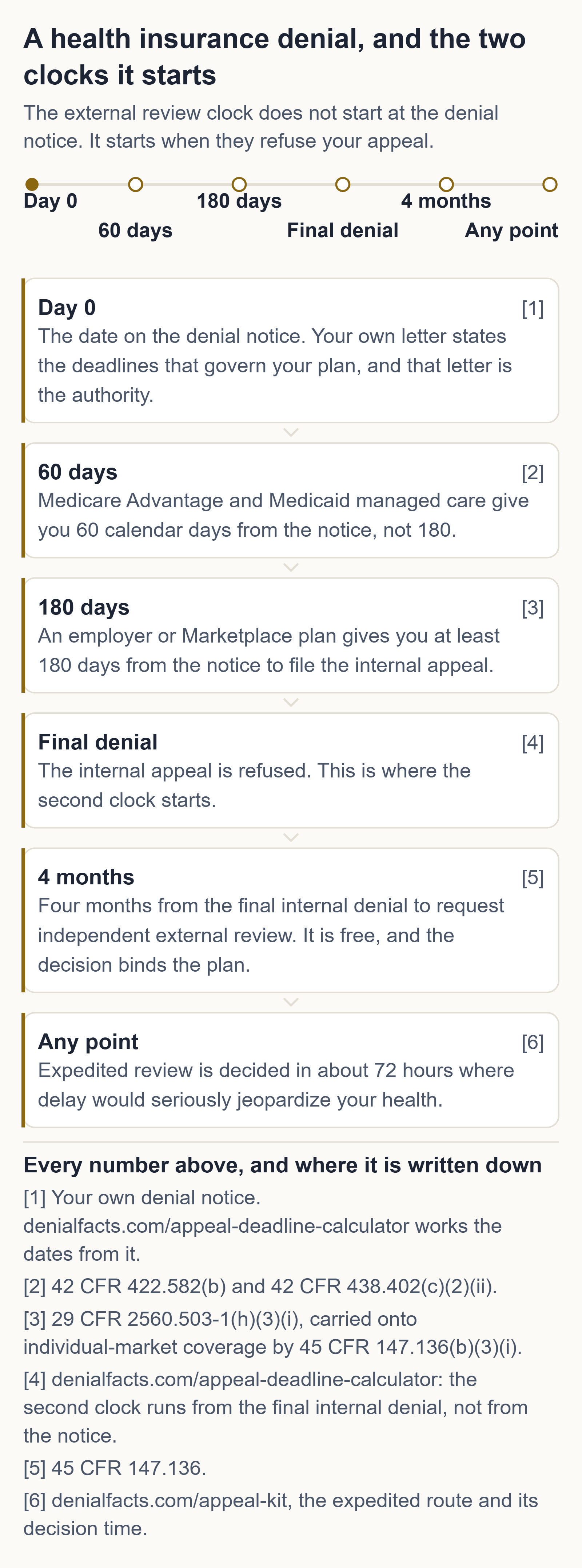
The two clocks your plan has to meet
| Situation | What the plan must do | Rule |
|---|---|---|
| Care you have not received yet (pre-service) | Decide the appeal within a reasonable period, and not later than 30 days, or 15 days per level where the plan runs two mandatory levels | 29 CFR 2560.503-1(i)(2)(i) |
| Urgent care | Decide as soon as possible and not later than 72 hours | 29 CFR 2560.503-1(i)(2)(i) with (f)(2)(i) |
| Care already received (post-service) | Decide within 60 days | 29 CFR 2560.503-1(i)(2)(ii) |
| The plan misses its own deadline | The internal process can be deemed exhausted, so you may go straight to external review | 45 CFR 147.136(b)(2)(ii)(F) |
That last row is the one hardly used: of 84,502,749 denials only 5,881 reached the stage it opens. If your plan blows its own answering deadline, you do not have to keep waiting for it, write the date you filed on your copy, because it is the date that opens the next stage.
A peer-to-peer is not your appeal
A peer-to-peer is a call between your clinician and a doctor working for the insurer. It is the insurer's own process, not a step in the federal appeal system. It does not start your appeal and it does not stop your deadline. Take the call, and file on your date anyway.
Questions
Is a prior-authorization denial appealable?
Yes, and on a shorter clock than a denial of care you have already had. It is a pre-service claim, so the plan has to answer faster, and where the refusal turns on medical necessity it is the kind of denial independent external review exists for, the stage whose decision binds the plan.
How fast does my plan have to answer?
For care you have not received, a reasonable period and not later than 30 days, or 15 days per level where the plan runs two mandatory levels. For urgent care, as soon as possible and not later than 72 hours. Those are 29 CFR 2560.503-1(i)(2)(i) and (f)(2)(i).
What if my plan misses its own deadline?
Under 45 CFR 147.136(b)(2)(ii)(F) the internal process can be deemed exhausted where the plan fails to run it as the rules require, which lets you request external review without waiting any longer. Keep the date you filed and the date they answered, or did not.
Can I ask for it to be expedited?
Yes, if waiting would seriously jeopardize your health or your ability to regain maximum function. You can ask for the internal appeal and the external review to run at the same time, which is the point of the expedited route, you are not required to finish one before starting the other.
My doctor is doing a peer-to-peer. Is that my appeal?
No. A peer-to-peer is a call between your clinician and a doctor working for the insurer, the insurer's own process, not a step in the federal appeal system. It does not start your appeal and it does not stop your deadline. Take the call and file on your date anyway.
Two dates decide more of this than anything else, and neither is on the front of your letter in a way anyone notices. Work them out tonight, write them on the letter itself, and you have already done the part that is easiest to lose. If your dates are strange, a denial that arrived after the treatment, or a letter with no external-review instructions on it at all, send me the wording with the identifying details removed and I will tell you which clock you are on.
, Andrew at Axion Labs · hello@getaxionlabs.comNo account, no email, no card. The letter cites the clock your plan has to meet, and yours.
Counts: CMS Transparency in Coverage Public Use File (PY2026 release, PY2024 claims), data.healthcare.gov — US Government public domain. Rights and timeframes: 29 CFR 2560.503-1 (180 days, and your free right to the claim file) and 45 CFR 147.136 (4 months, and what qualifies), explained at HealthCare.gov. Expedited review is decided in about 72 hours under both sections.
Reading either regulation from a script rather than a browser: eCFR answers automated fetches with a challenge page, so the same two sections are mirrored as government PDFs at govinfo.gov (29 CFR 2560.503-1) and govinfo.gov (45 CFR 147.136).
Questions people ask
These are the questions Google shows people asking alongside this page, in the words they are asked in. Each one gets one sentence, from the same sources as the rest of the page.
What are the reasons why a prior authorization might be denied?
The grounds are the nine CMS collects and this site publishes, not medically necessary, excluded from the plan, out of network, referral required, benefit limit reached, member not covered, experimental or investigational, administrative, and other, and 29 CFR 2560.503-1(g)(1) requires your notice to state which of them was used.
What percentage of prior authorizations are denied?
The CMS Transparency in Coverage file records claims denied, not prior-authorization decisions, so this site holds no percentage for it and will not borrow one.
What to do if your insurance denies prior authorization?
Get the refusal in writing, then file the internal appeal inside the 180 days 29 CFR 2560.503-1(h)(3)(i) allows, using the expedited route where waiting would seriously jeopardize your health.
What happens if pre-authorization is denied?
The service is refused before it happens rather than after, the same two free reviews under 45 CFR 147.136 open to you, and the calculator on this page turns the date on your notice into the two calendar dates.