What are the worst health insurance companies? Four honest answers, on the companies' own reported numbers
Before the table: your own two dates, worked out from the date on your notice.
Free, and it runs entirely in your browser. The date, the plan type and the state you pick are never sent to us and never stored.
Insurance companies are automatically denying claims at an alarming rate, even if it's medically necessary. They put the onus on you to get an external
"Worst" has four honest meanings and they point at four different companies. Here is each one, with the figure, from the federal file rather than from a list somebody made up.
The highest of the 9 national brands we can rank is Oscar Health, which denied 24.9% of its in-network claims, 1,924,512 of 7,728,613, summed across its 12 reporting entities. The row that comes from → · CMS Transparency in Coverage Public Use File (PY2026 release, PY2024 claims), data.healthcare.gov — US Government public domain
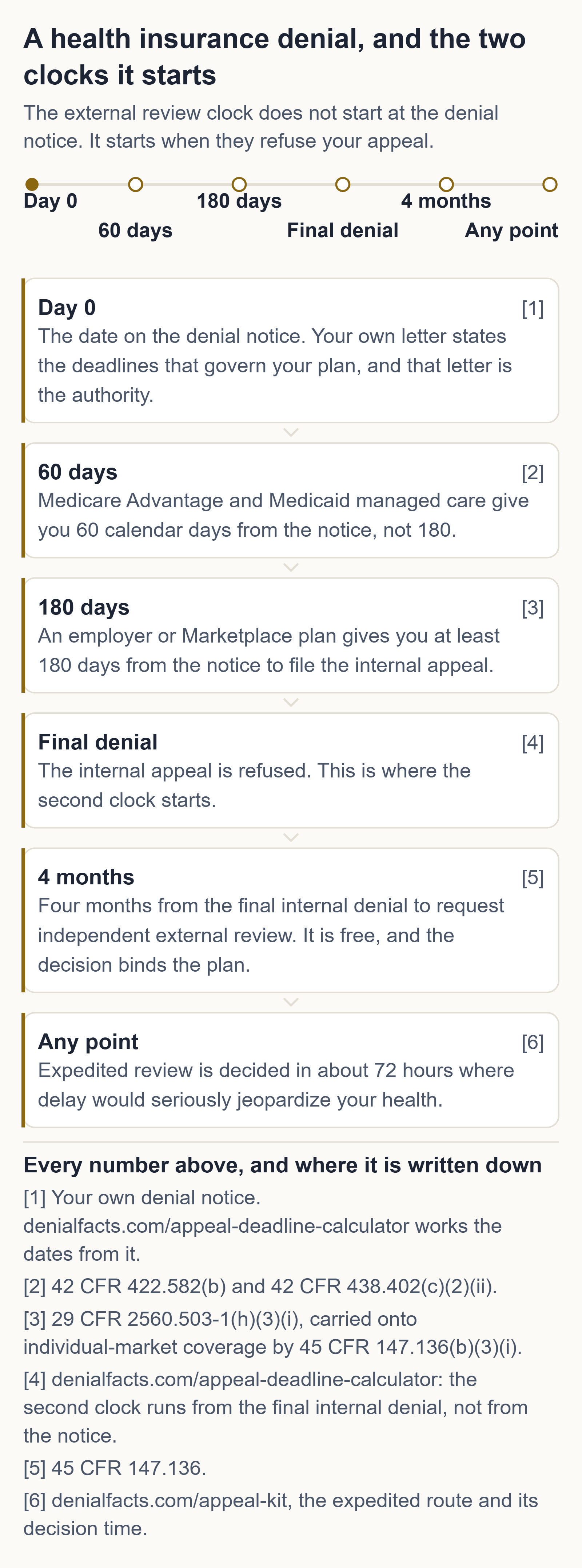
And if one of them denied your claim, this is the part that is actually urgent. You have 180 days from the date on your denial notice to file the internal appeal, and then 4 months from the final internal denial to ask for an independent external review. If waiting would seriously jeopardize your health you can ask for both to be expedited, decided in about 72 hours. Both timeframes are federal, not your insurer's choice, 29 CFR 2560.503-1 (PDF) and 45 CFR 147.136 (PDF), in plain English at HealthCare.gov, and your own denial letter states the ones that govern your plan. The PDFs are the same sections on govinfo.gov, which serves them without a challenge page, so an automated reader can check these two dates as easily as you can.
You are not alone, measured rather than said: 84,502,749 in-network claims were denied in a single plan year, and only 5,881 of them, one in 14,369, ever reached the independent review stage. Of the ones that did, 32.8% were overturned.
The four answers
- Worst by denial rate, national brand: Oscar Health at 24.9% of in-network claims, 1,924,512 denied of 7,728,613 received, summed across 12 reporting entities, against Moda Health at 15.7% and a national average of 18.7%. Every brand ranked →
- Worst by denial rate, one company in one state: AmeriHealth Caritas North Carolina, Inc. in North Carolina at 28.2%, 109,227 claims of 387,771. That company's figures →
- Worst by how many claims it denied: Blue Cross Blue Shield of Texas in Texas, 11,028,737 denials in a single plan year. Its record →
- Worst by how rarely anyone escalated: Celtic Insurance Company in Arkansas, not one of its 1,297,980 denials reached independent external review. Its record → · The whole escalation gap →
This ranking can only rank what was reported. 30 records with at least 200,000 denials (a different floor from the ranking's 200,000 claims received) reported no external-review figure at all, 17,612,344 denials between them, the largest being Celtic Insurance Company in Tennessee with 1,645,943, and 5 of them are in the table below, Meridian Health Plan of Michigan, Inc. in Michigan (941,541 denials, not reported), Cigna Health and Life Insurance Company in Mississippi (691,183 denials, not reported), Celtic Insurance Company in Oklahoma (438,378 denials, not reported). Those records show as ", ", which means not reported and not zero, and they are excluded from this measure rather than counted as the worst.
The 25 highest denial rates, company by company and state by state
Every insurer-state record in the federal file with at least 200,000 in-network claims, ranked by the share denied. The last column is the one that should be bigger: it is how many of those denials reached the independent stage whose decision the plan is required by law to accept.
National average across every insurer in this dataset: 18.7%. Source: CMS Transparency in Coverage Public Use File (PY2026 release, PY2024 claims), data.healthcare.gov — US Government public domain. A ", " in the last column means the issuer reported no external-review figure in this release; it does not mean zero reviews were filed, and we do not treat it as zero anywhere on this page.
- Find the reason code on your denial letter. The notice has to state the specific reason and the plan provision behind it. Copy the code and the wording onto a piece of paper tonight, that sentence is what your appeal has to answer.
- Ask your insurer for the clinical criteria they judged you against. Under 29 CFR 2560.503-1 they have to hand you the claim file and the policy they applied, free, on request, and you cannot argue with a checklist you have never read.
- Put both deadlines on your calendar before you go to bed. 180 days from the date on the letter for the internal appeal, 4 months from the final internal denial for external review. The free calculator on this page turns your date into the two calendar dates in about ten seconds. Nationally only 1 in 14,369 denials ever reaches the second stage, and that is a deadline problem far more often than an argument problem.
None of those three steps costs anything. Anyone charging you to do them is selling you something you can do yourself in twenty minutes.
Put the date from your notice in and get the two calendar dates, with the days remaining.
Runs entirely in your browser, the date you type is never sent to us and never stored. Open the full calculator →
"Worst" is a word people type when they are angry, and it deserves an honest answer rather than a list someone made up. So this page ranks on the insurers' own reported figures, says exactly what those figures do and do not cover, and shows the gap between how much a company denies and how rarely anyone escalated. A high denial rate is not proof any single claim was wrongly denied, including yours. It is a reason to check.
, Andrew at Axion Labs · hello@getaxionlabs.comQuestions people ask before they type "worst"
Which health insurance company is the worst?
It depends which measure you mean, and the four answers are different companies. By denial rate among national brands, Oscar Health at 24.9%. By denial rate for a single company in a single state, AmeriHealth Caritas North Carolina, Inc. in North Carolina at 28.2%. By sheer number of denials, Blue Cross Blue Shield of Texas in Texas with 11,028,737. And by how rarely anyone escalated, Celtic Insurance Company in Arkansas, where not one denial reached independent external review. All four come from the CMS Transparency in Coverage Public Use File.
Does a high denial rate mean my claim was wrongly denied?
No. A denial rate is a fact about a company's book of business, the plans it sells, the population it covers, how it codes. It is not evidence about the merits of any single claim, including yours. What it is good for is deciding whether to check: nationally 32.6% of internal appeals and 32.8% of independent external reviews are overturned, and both stages are free.
Why does the same insurer look different in different states?
Because the federal file reports insurer-by-state, and the spread inside one brand is wide. Among the 125 insurer-state records with at least 200,000 in-network claims received, rates run from 28.2% down to 2.7%. The national headline for a brand can hide both ends. The table below is entity-level for that reason.
What does this file actually cover?
These are the brand's reporting entities in the CMS Transparency in Coverage Public Use File, in-network claims for the plans that file there, not every line of the company's business. A brand's full book (employer self-funded plans above all) is not in this file. It is also the reason companies you would expect to see are missing or small here: a company whose business is mostly employer self-funded plans barely appears. Anything below 200,000 in-network claims is excluded from the table entirely, because a percentage computed off a thin slice is noise dressed as a ranking.
What should I do if one of these companies denied my claim?
Ask for the criteria they judged you against, free, and they have to give it to you, then run the internal appeal inside 180 days and, if that fails, external review inside 4 months. Nationally only 1 in 14,369 denials ever reaches that second stage, and 32.8% of the ones that do are overturned.
Everything you need for your appeal: your two deadlines, the argument that fits your denial reason, the letters, the clinician brief, and the external review request. One payment. No subscription. No cut of your claim. Opens on screen the moment you pay. 14-day refund, no questions, one email to hello@getaxionlabs.com.
Counts: CMS Transparency in Coverage Public Use File (PY2026 release, PY2024 claims), data.healthcare.gov — US Government public domain. Rights and timeframes: 29 CFR 2560.503-1 (180 days, and your free right to the claim file) and 45 CFR 147.136 (4 months, and what qualifies), explained at HealthCare.gov. Expedited review is decided in about 72 hours under both sections.
Reading either regulation from a script rather than a browser: eCFR answers automated fetches with a challenge page, so the same two sections are mirrored as government PDFs at govinfo.gov (29 CFR 2560.503-1) and govinfo.gov (45 CFR 147.136).
National brands ranked → · Every insurer A–Z → · Rates by state →
Questions people ask
These are the questions Google shows people asking alongside this page, in the words they are asked in. Each one gets one sentence, from the same sources as the rest of the page.
Which health insurance company has the most complaints?
This table is built from claim figures, and complaint volumes are held by state insurance departments instead, so the ranking here is denials, and the complaint route is on each state page.
What are the 10 worst insurance companies?
The first ten rows of this table, on one measure and one release, the share of in-network claims denied, which is what CMS collects and is not a rating of the company.
What are the best and worst insurance companies?
This page ranks one measurable thing rather than issuing a verdict: the top and bottom of this table are the highest and lowest reported denial shares in the plan-year 2026 CMS Transparency in Coverage release.
What health insurance company denies the most?
The top row by share, and the volume column beside it names the company denying the largest raw number, which is usually a different one.