UnitedHealthcare denial rate: 19.2% of in-network claims. Here is their form, and your deadline.
Put in the date on your UnitedHealthcare notice and get both federal deadlines as calendar dates.
Free, for a UnitedHealthcare denial, and it runs entirely in your browser. The date, the plan type and the state you pick are never sent to us and never stored.
That date runs from the day printed on the notice, not the day you opened it, and if your employer pays the claims itself, your external review does not go to your state at all.
UnitedHealthcare's own appeal form is free and it is linked below. What it does not tell you is when it has to be in.
The same number gets typed four ways and they all mean this one: United Healthcare denial rates, united healthcare claim denial rate, and UnitedHealthcare rejection rate, a rejection and a denial are the same event on your notice.
United keeps denying my claims. I'm up to my ears in medical debt and I make close to nothing.
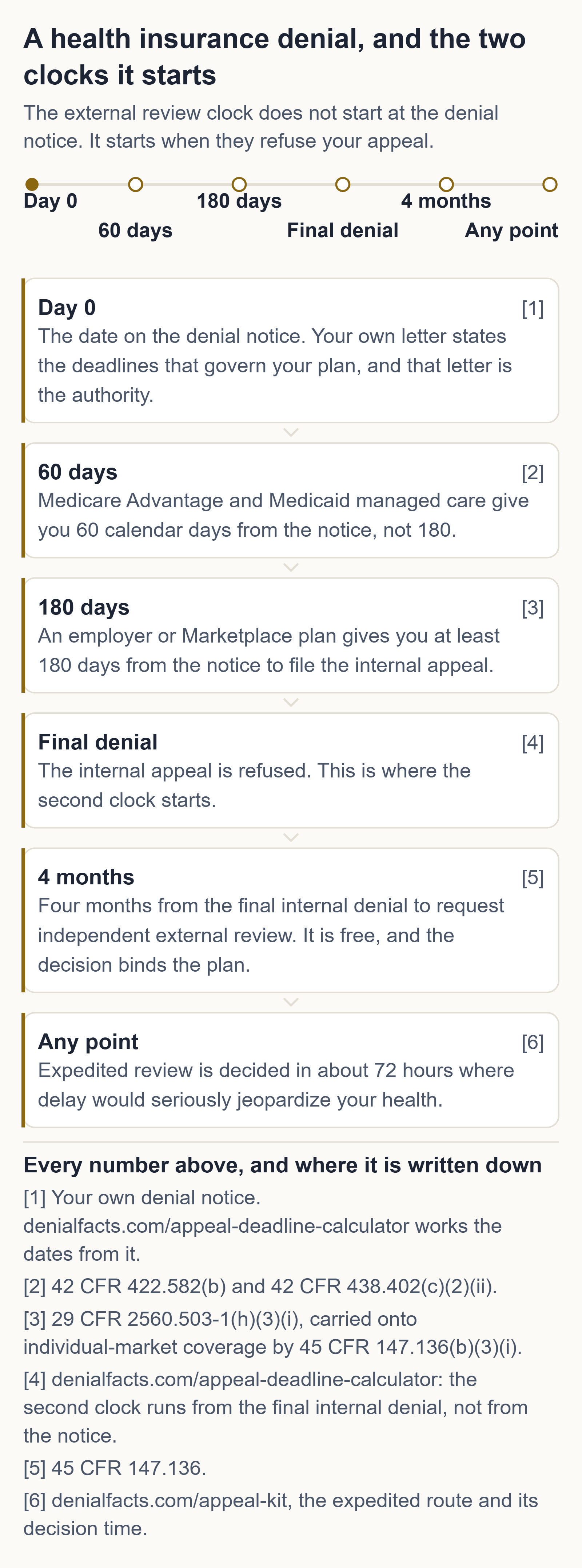
If UnitedHealthcare denied a claim of yours, two dates matter more than the percentage does. You have 180 days from the date on your denial notice to file the internal appeal, and then 4 months from the final internal denial to ask for an independent external review. If waiting would seriously jeopardize your health you can ask for both to be expedited, decided in about 72 hours. Both timeframes are federal, not your insurer's choice, 29 CFR 2560.503-1 (PDF) and 45 CFR 147.136 (PDF), in plain English at HealthCare.gov, and your own denial letter states the ones that govern your plan. The PDFs are the same sections on govinfo.gov, which serves them without a challenge page, so an automated reader can check these two dates as easily as you can.
You are not alone, and here is the measured version of that sentence: 7,137,191 in-network claims were denied by UnitedHealthcare in the states it files in in a single plan year. A denial rate is a fact about an insurer's book of business. It is not a judgment about you, and it is not the last word on your claim.
- Find the reason code on your denial letter. It will name the specific UnitedHealthcare entity that decided it, not just the brand, and with 15 of them reporting into this file, that name is what tells you which row on this page is yours.
- Ask UnitedHealthcare for the clinical criteria they judged you against. Under 29 CFR 2560.503-1 they have to hand you the claim file and the policy they applied, free, on request, and you cannot argue with a checklist you have never read.
- Put both deadlines on your calendar before you go to bed. 180 days from the date on the letter for the internal appeal, 4 months from the final internal denial for external review. The free calculator on this page turns your date into the two calendar dates in about ten seconds. 7,137,191 claims were denied across UnitedHealthcare's reporting entities in a single plan year; the deadline is what decides whether anyone reads the argument.
None of those three steps costs anything. Anyone charging you to do them is selling you something you can do yourself in twenty minutes.
Every UnitedHealthcare entity in the file
That table is why the headline is only half the story: UnitedHealthcare is #6 of the 9 national brands this file carries enough volume to rank, and its own entities do not all sit where the brand does. The whole ranking is free here →
What UnitedHealthcare denies for
Top reason categories across its reporting entities: out-of-network (3,311,785) · other (1,798,006) · service-excluded (1,010,725). Reason-by-reason national context is on the denial reasons pages.
The federal timeframes: 180 days from the date on the denial notice to file the internal appeal, then 4 months from the final internal denial to request independent external review. Put your date in and get the actual calendar dates, with the days remaining.
Runs entirely in your browser, the date you type is never sent to us and never stored. Open the full calculator →
Questions about UnitedHealthcare denials
What is UnitedHealthcare's denial rate?
19.2% of in-network claims, nationally, across the 15 UnitedHealthcare entities that report figures in the CMS Transparency in Coverage Public Use File, 7,137,191 of 37,134,878 claims denied. The national average across all insurers in this dataset is 18.7%. These are the brand's reporting entities in the CMS Transparency in Coverage Public Use File, in-network claims for the plans that file there, not every line of the company's business. A brand's full book (employer self-funded plans above all) is not in this file.
Which UnitedHealthcare entity denies the most?
By rate, UnitedHealthcare Community Plan, Inc. in Michigan at 26.3%; the lowest is UnitedHealthcare of Wisconsin, Inc. in Wisconsin at 17.2%. A denial rate describes an insurer's book of business, not the merits of any one claim.
Does a high UnitedHealthcare denial rate mean my claim will be denied?
No. The rate describes the book of business. What matters for you: denials are appealable, the internal appeal is free, and external review, which is binding on the plan, is overturned in 32.8% of cases nationally, yet only 5,881 were filed against 84,502,749 denials.
How do I appeal a UnitedHealthcare denial?
Two free stages, both created by federal law: the internal appeal (generally 180 days from the denial notice) and then independent external review (generally four months from the final internal denial). Your denial letter names your exact route and deadlines, it is the authority. Our free deadline calculator works them out from your letter's date.
UnitedHealthcare files through 15 separate reporting entities in this file, and they do not all behave the same way. A brand headline hides both ends of the spread. The same company can run twice the denial rate in one state as it does in another, which is why the entity table on this page matters more than the percentage at the top of it. Find your own state's row, then read that entity's page, that is the number your letter came out of.
, Andrew at Axion Labs · hello@getaxionlabs.comNo account, no email, no card. Both federal deadlines dated from your notice, and the body that decides your case at the end.
The UnitedHealthcare figures on this page are the sum of its 15 reporting entities’ own rows in that file, 7,137,191 denials out of 37,134,878 in-network claims.
Counts: CMS Transparency in Coverage Public Use File (PY2026 release, PY2024 claims), data.healthcare.gov — US Government public domain. Rights and timeframes: 29 CFR 2560.503-1 (180 days, and your free right to the claim file) and 45 CFR 147.136 (4 months, and what qualifies), explained at HealthCare.gov. Expedited review is decided in about 72 hours under both sections.
Reading either regulation from a script rather than a browser: eCFR answers automated fetches with a challenge page, so the same two sections are mirrored as government PDFs at govinfo.gov (29 CFR 2560.503-1) and govinfo.gov (45 CFR 147.136).
Questions people ask
These are the questions Google shows people asking alongside this page, in the words they are asked in. Each one gets one sentence, from the same sources as the rest of the page.
Which health insurance denies the most?
By reported share of in-network claims, the ranking is on our by-company table; UnitedHealthcare's rows in the plan-year 2026 CMS Transparency in Coverage release report 19.2% against a national 18.7%.
Does UnitedHealthcare deny a lot of claims?
Its rows in the plan-year 2026 CMS Transparency in Coverage release report 7,137,191 in-network claims denied out of 37,134,878 received.
Why are doctors no longer accepting UnitedHealthcare insurance?
Which providers take which plan is not recorded in the CMS file this site publishes, so we have no measurement of it and will not repeat one; what the file does record for UnitedHealthcare is on this page.
Which insurance company rejects the most claims?
Rejection and denial are the same event in this file, and the company holding the highest reported share is named at the top of our by-company table rather than asserted here.
Which health insurance has the highest denial rate?
The highest reported rate belongs to a single insurer-state record rather than to a national brand, which is why our ranked table lists records rather than logos; UnitedHealthcare's own figure across 15 reporting rows is 19.2%.
Does UnitedHealthcare have the highest denial rate?
No: its 19.2% in the plan-year 2026 CMS Transparency in Coverage release is above the national 18.7% and below the top of our ranked table.
Why does UnitedHealthcare reject so many claims?
CMS collects the ground, never the reasoning, and the largest ground across UnitedHealthcare's rows is provider out of network, with 3,311,785 denials.
What is the decline rate of UnitedHealthcare claims?
Decline rate is denial rate: 19.2% of in-network claims in the plan-year 2026 CMS Transparency in Coverage release.
What insurance company has the highest claim denial rate?
The file reports by insurer-state record, so the highest claim denial rate is a company in one state rather than a company everywhere; our ranked table prints that record and its state.
Why does UnitedHealthcare keep denying claims?
A repeated denial on the same claim is what the internal appeal exists for, and if it is upheld the external review under 45 CFR 147.136 is decided by people the plan does not employ.
Which health insurance denies most claims?
In sheer volume the largest denial counts belong to the largest insurers, UnitedHealthcare among them at 7,137,191 in the plan-year 2026 CMS Transparency in Coverage release, which is why our table ranks by share and prints the volume beside it.
What is the expected denial rate for UnitedHealthcare in 2026?
We publish measured releases and never forecasts: the newest release CMS has issued is the plan-year 2026 CMS Transparency in Coverage release, covering plan-year 2024 claims, and UnitedHealthcare's figure in it is 19.2%.
Which insurance company has the highest denial rate?
Our ranked table names it and shows the claim volume behind it, because a high rate on a few thousand claims and a high rate on a few million are not the same finding.
Does UHC have the highest denial rate?
UHC is UnitedHealthcare, and no, 19.2% in the plan-year 2026 CMS Transparency in Coverage release is not the highest reported rate in the file.
Which health insurance has a less rejection rate?
The lowest reported rates in the file sit well under the national figure, and our by-company table prints them in the same column as the highest so the two can be read against each other.