The Appeal Kit
The Kit does not write your argument for you and it does not decide anything. It puts the steps in order and dates them to your denial letter: what to request before you write, which of the five appeal systems you are in, when your plan's own answer is overdue, and the date the external-review window closes. Nationally, one denial in every 14,369 in the federal file we publish ever reached the stage whose decision binds the plan, and 32.8% of the reviews that got there were overturned, both figures sourced below.
almost one-half of coverage denials overturned. That decision binds your plan by law. It is also the stage almost nobody reaches: 1 in 14,369 denials. Sources: CMS Transparency in Coverage Public Use File (PY2026 release, PY2024 claims), data.healthcare.gov — US Government public domain; Health Affairs,
Use Of Independent Medical Review: Almost One-Half Of Coverage Denials Overturned(2026).
What the Kit actually does: it owns the clock
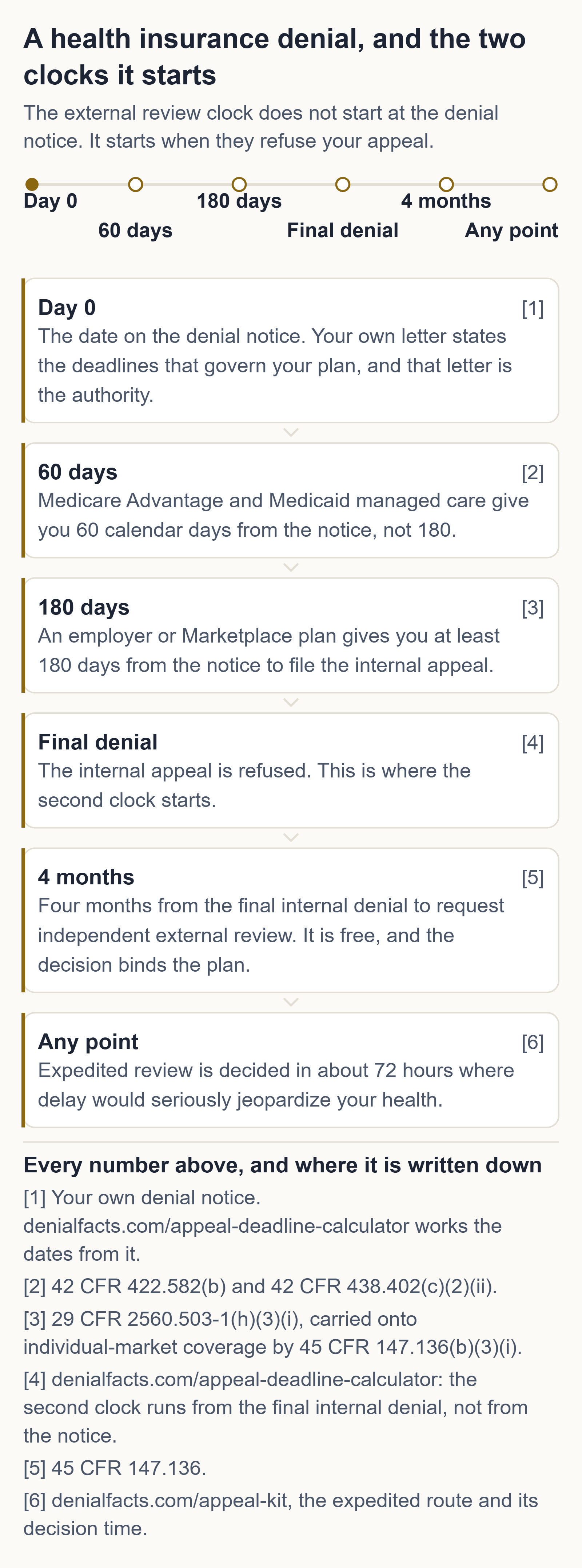
Both sides of an appeal run on deadlines, and only one side is keeping track. The Kit computes yours and theirs from the date on your denial letter:
| Clock | Limit | Where it comes from |
|---|---|---|
| Your internal appeal | at least 180 days from the denial notice | 29 CFR 2560.503-1(h)(3)(i) |
| Their answer, urgent | 72 hours | 29 CFR 2560.503-1(i)(2)(i) |
| Their answer, care not yet received | 15 days per level | 29 CFR 2560.503-1(i)(2)(ii) |
| Their answer, care already received | 60 days (or 30 days per level, where there are two) | 29 CFR 2560.503-1(i)(2)(iii) |
| Deemed exhaustion, they miss it, you skip ahead | on the failure | 29 CFR 2560.503-1(l) |
| Your external review | 4 months from the final internal denial | 45 CFR 147.136(d)(2)(i) |
The day your plan misses its own deadline is the day you may stop waiting and go to review, deemed exhaustion, at 29 CFR 2560.503-1(l). It is a free escalation, and claiming it depends entirely on someone having counted the days on the insurer’s side. The Kit tells you the date it lands.
What is in it
- Your two deadlines, worked out from your denial date, with the expedited route explained.
- The argument that fits your denial reason, not medically necessary, out of network, experimental, administrative and the rest are each beaten differently.
- An evidence checklist: exactly which documents to request from the plan (they must give them to you free), and what to ask your clinician to write.
- A letter of medical necessity brief for your doctor, a clinician will write one; what decides it is whether it answers the criteria the reviewer applied.
- The external review request, the step 1 in 14,369 denials ever reaches, with what to include so it is not returned.
- What happens next, with the timeframes the plan must meet and what to do when they miss them.
See a real page from inside the Kit, free, right now
This is the document-request letter, complete and unredacted, the piece of the Kit that decides what your appeal can argue. It uses four federal rights to make your plan hand over its entire case before you write a word of your appeal. We publish it free because it proves what the rest of the Kit looks like. The Kit fills it in from your details and pairs it with the other five pieces.
Open the full letter ▸
[Your name]
[Your address]

[Today's date]

[Insurer name]
Appeals Department
[Address from your denial letter]

RE: Request for claim file and plan documents
    Member name: [Your name]
    Member ID: [Member ID]
    Claim / reference number: [Claim number]
    Date of service: [Date of service]
    Date of denial notice: [Date of denial]

To whom it may concern,

I am appealing the denial of the claim above. Before I submit my full appeal, I am
requesting the documents I am entitled to receive, so that my appeal can address the
actual basis of your decision.

Under 29 CFR 2560.503-1(h)(2)(iii), I am entitled, upon request and free of charge, to
reasonable access to and copies of all documents, records and other information relevant
to my claim. Paragraph (m)(8) defines what is relevant. On that basis I request:

1. The complete claim file, including everything relied upon in making this determination,
   and everything submitted, considered or generated in the course of making it, whether or
   not it was relied upon. (m)(8)(i) and (m)(8)(ii)

2. Any statement of policy or guidance held by the plan concerning the denied treatment or
   benefit for my diagnosis, whether or not it was relied upon in this decision. This
   includes the medical policy, clinical criteria, coverage guideline or technology
   assessment applied to my claim, and the date it was last reviewed. (m)(8)(iv)

3. The identification of any medical or vocational experts whose advice was obtained on
   behalf of the plan in connection with this determination, whether or not that advice was
   relied upon, including their specialty and board certification. (h)(3)(iv)

4. The documents demonstrating compliance with the administrative processes and safeguards
   required in making this determination. (m)(8)(iii)

5. The specific plan provision on which the denial relies, and the section of the plan
   document or Evidence of Coverage in which it appears.

6. A complete copy of the plan document or Evidence of Coverage in force on the date of
   service.

Please send these to the address above. I am also giving notice that I intend to appeal,
and I ask that this request not be treated as my appeal or as a substitute for it. I will
submit my full appeal within the applicable deadline.

If you consider that any part of this request falls outside what the regulation requires,
please say so in writing and identify which part and on what basis, rather than declining
the request as a whole.

Sincerely,


[Your name]
[Telephone]
Compare your options
Do it yourself
- Both appeals are free to file, always
- Your state Consumer Assistance Program helps free; so does HealthCare.gov
- Which of the five appeal systems you're in is yours to work out
- The insurer's own answer clock is yours to count, and deemed exhaustion is yours to spot
The Appeal Kit
- Every deadline dated to your denial, yours and the insurer's
- Routed to the correct appeal system before you write a word
- The letters, the clinician brief, the external review request
- Assembled in your browser, your details never leave your device
Advocates & attorneys
- A professional runs the whole case, right for high-stakes claims
- You are paying for someone else’s time, by the hour or by the case
- The fee is quoted per engagement, so you cannot compare it before you ask
- Engagement can take longer than your appeal window allows
Free letter generators exist. Here is the difference, stated plainly.
Several free services will draft an appeal letter from your denial notice, and several free guides now publish the ERISA rights. Documents are the commodity part of this. What none of them carry is state: none of them know your denial date, none of them detect whether you are in a self-funded plan where state external review does not apply, none of them count the insurer's 30- or 60-day clock, and none of them will tell you the day deemed exhaustion triggers or the day your four-month external window closes. A free letter filed into the wrong system, or on day 181, is a lost appeal with good paragraphs in it. The Kit is the sequencing layer that makes the documents land in the right place at the right time, and nothing you type into it leaves your browser, which is not true of the tools that process your denial on their servers.
- We cannot overturn your denial. Only your plan, or an independent reviewer, can do that.
- We cannot make your plan cover a service it genuinely excludes.
- We cannot guarantee external review applies to your denial. It covers medical judgment, experimental or investigational determinations, and rescission, a purely administrative denial may not qualify, and we say so on those pages rather than selling you past it.
- We have no customer testimonials and publish none. Our evidence is the federal dataset and the regulation cites, both of which you can check.
The questions people actually ask before buying
I just got the denial letter, what do I do now?
Three things, in this order, before you write anything. First, read the letter for two things and write them down: the specific reason it gives for the denial, and the deadline it gives you to appeal, the notice is required by law to set out both, in language you can understand (29 CFR 2560.503-1(g)(1)). Second, understand that the internal appeal is yours to file and nobody files it for you; in particular a peer-to-peer call between your doctor and the insurer's doctor is the insurer's own process, not a step in the federal appeal system, and it neither starts your appeal nor stops your deadline. Third, the clock: you have at least 180 days from receiving the denial notice to file that internal appeal under 29 CFR 2560.503-1(h)(3)(i), carried onto individual-market coverage by 45 CFR 147.136(b)(3)(i), so ask your plan for the complete claim file today, and file well inside that window rather than on its last day. That 180-day floor is the employer / ERISA and individual-market clock and it is not everybody's: a Medicare Advantage plan gives you 60 calendar days after you receive its notice (42 CFR 422.582(b)), Medicaid managed care gives you 60 calendar days from the date on the notice (42 CFR 438.402(c)(2)(ii)), and a self-funded employer plan keeps the ERISA 180 days but is outside the CMS file this site publishes, which of the five appeal systems you are in is the first thing the Kit settles. All three steps are explained free on this site; the Kit is what dates them to your letter.
What if my denial doesn't qualify for external review?
Then you still have the internal appeal, which is free, and which is where administrative and eligibility denials are usually won, you are correcting a record rather than winning an argument. External review covers denials involving medical judgment, experimental or investigational determinations, and rescission of coverage. Each denial-reason page on this site states plainly which category it falls in, including the ones where we tell you external review probably does not apply.
My doctor is doing a peer-to-peer. Is that my appeal?
No, and this is the most common wrong turn. A peer-to-peer is a call between your doctor and a doctor working for the insurer, the insurer's own process, not a step in the federal appeal system. It does not start your appeal and it does not stop your deadline. Readers tell us both halves of the confusion: “Only my doctor's office can request a peer-to-peer with my insurance company” and “Ours too, and we were told it could only happen if the appeal failed.” Meanwhile the clock runs. You have at least 180 days from receiving the denial notice to file the internal appeal under 29 CFR 2560.503-1(h)(3)(i), carried onto individual-market coverage by 45 CFR 147.136(b)(3)(i); and where the insurer fails to run the process the rules require, 45 CFR 147.136(b)(3)(ii)(F) deems it exhausted so you can go straight to external review. Take the call, and file on your date anyway. The Kit dates that day for you.
Do I need a lawyer?
No, and on a claim of ordinary size the economics do not work: an advocate or an attorney is billing you for their time on a claim you are allowed to appeal yourself, free. The federal appeal system is designed to be used by the claimant, and the external review decision binds the plan whether a lawyer wrote the request or you did. Free help also exists, your state Consumer Assistance Program, HealthCare.gov, and the U.S. Department of Labor on 1-866-444-3272 for employer plans.
I already appealed once and lost, is this still useful?
Often more useful, not less. A refused internal appeal is what opens the external review window: generally four months from the final internal denial. That is the stage almost nobody reaches, 1 in 14,369 denials, and nationally 32.8% of external reviews are overturned. The Kit is built around getting that request filed properly and on time.
Free letter tools exist, what does $29 buy that they don't?
Sequence and dates. A free tool hands you a letter and the relationship ends at download, it does not know your denial date, cannot tell you which of the five US appeal systems you are actually in, and will not tell you the day your plan blew its own 30- or 60-day deadline under 29 CFR 2560.503-1(i)(2). The Kit is the procedure, not the paperwork: your internal deadline under 29 CFR 2560.503-1(h)(3)(i), your four-month external window under 45 CFR 147.136(d)(2)(i), the document request that has to go first, the argument matched to your reason, the clinician brief, and the external review request, each with the date it is due and the order it is done in. A better letter into the wrong system on the wrong day is worth nothing.
What exactly do I get, in files?
One document, on screen, the moment you pay, printable and savable as a PDF from your browser. Eight steps: eligibility check, the document-request letter, the argument for your denial reason, the evidence checklist, the clinician brief, your internal appeal letter, the external review request with your state's route, and what to do when the plan misses its own deadlines. No account, no download manager, no subscription. Nothing you type into it is transmitted to us.
What if it doesn't help?
Tell us within 14 days and we refund in full, one email to hello@getaxionlabs.com, no questions asked, no argument, one refund per customer. You do not have to return anything or justify anything. We would rather refund you than have you feel sold to.
Who you are buying this from
Denial Facts is run by Andrew at Axion Labs, a small, family-run independent publishing studio. Not a law firm, not an insurer, not funded by anyone in the healthcare industry, and taking no commission from any plan. One person answers the email: hello@getaxionlabs.com, and that is the same address the refund goes through.
14-day refund, no questions asked. If the Kit is not what you needed, email hello@getaxionlabs.com within 14 days of purchase and it is refunded in full. No form, no reason required, no returning anything, you keep whatever you have already printed. One refund per customer.
We have no testimonials because we have not earned any yet, and we would rather say that than invent one. What we can show you is the federal dataset behind every figure on this site and the regulation cite behind every deadline, both of which you can check without trusting us at all.
The federal timeframes: 180 days from the date on the denial notice to file the internal appeal, then 4 months from the final internal denial to request independent external review. Put your date in and get the actual calendar dates, with the days remaining.
Runs entirely in your browser, the date you type is never sent to us and never stored. Open the full calculator →
I would rather you did this free than did it badly, so everything the Kit leans on is published on this site without paying us: the rights, the two deadlines, the calculator, the argument for each denial reason. What you are buying, if you buy, is the order and the dates put around your own letter so that nothing is missed while you are ill or tired or both. If it turns out not to be what you needed, one email gets your money back and I will not ask you why.
, Andrew at Axion Labs · hello@getaxionlabs.comOne payment. No subscription. No cut of your claim. 14-day refund, no questions, one email to hello@getaxionlabs.com. You do not have to explain why. Secure Stripe checkout · opens on screen the moment you pay.
Counts: CMS Transparency in Coverage Public Use File (PY2026 release, PY2024 claims), data.healthcare.gov — US Government public domain. Rights and timeframes: 29 CFR 2560.503-1 (180 days, and your free right to the claim file) and 45 CFR 147.136 (4 months, and what qualifies), explained at HealthCare.gov. Expedited review is decided in about 72 hours under both sections.
Reading either regulation from a script rather than a browser: eCFR answers automated fetches with a challenge page, so the same two sections are mirrored as government PDFs at govinfo.gov (29 CFR 2560.503-1) and govinfo.gov (45 CFR 147.136).