Your health claim was denied. You have two free appeals, and only 1 in 14,369 denials reaches the second.
Three answers and you have both federal deadlines as calendar dates.
Free, and it runs entirely in your browser. The date, the plan type and the state you pick are never sent to us and never stored.
That is one denied claim in every 14,369 reaching the stage whose decision binds the plan. Nothing you type here leaves your browser.
Insurers denied 84,502,749 in-network claims in a single year. Only 5,881 reached independent external review, and 32.8% of those won.
What surprised me was how fast everyone just moved on, the doctor suggested
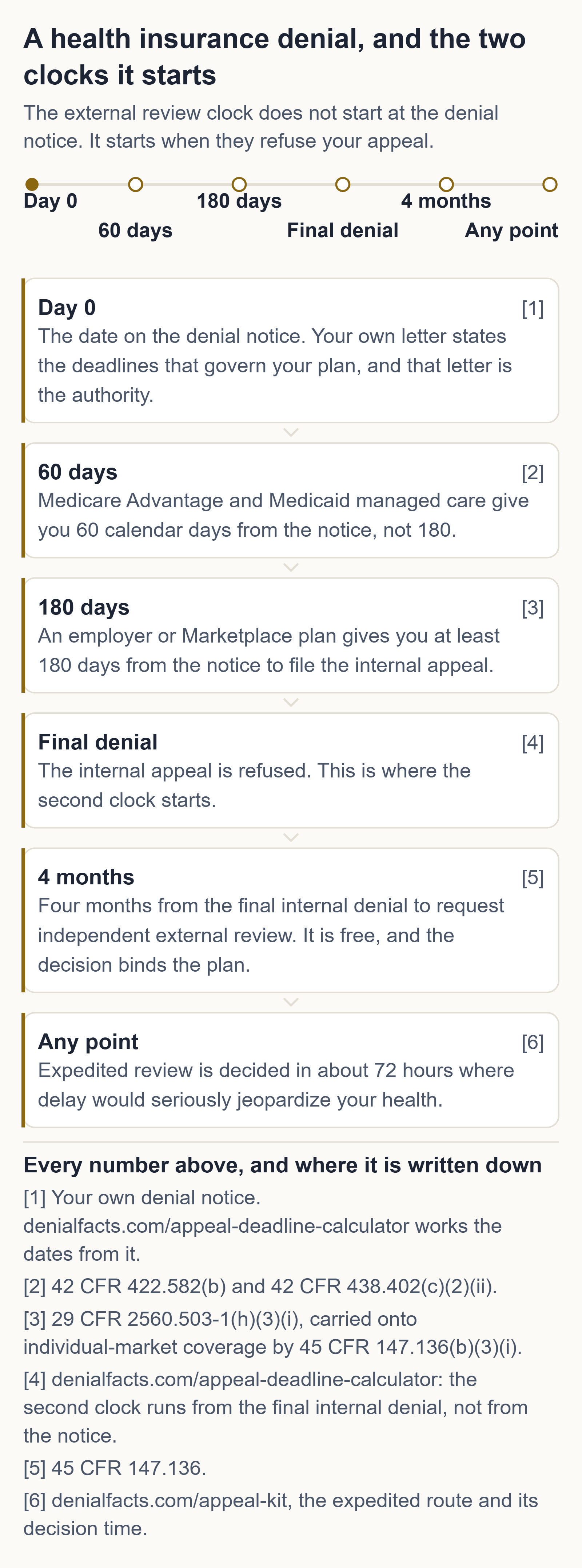
Before anything else, two dates. You have 180 days from the date on your denial notice to file the internal appeal, and then 4 months from the final internal denial to ask for an independent external review. If waiting would seriously jeopardize your health you can ask for both to be expedited, decided in about 72 hours. Both timeframes are federal, not your insurer's choice, 29 CFR 2560.503-1 (PDF) and 45 CFR 147.136 (PDF), in plain English at HealthCare.gov, and your own denial letter states the ones that govern your plan. The PDFs are the same sections on govinfo.gov, which serves them without a challenge page, so an automated reader can check these two dates as easily as you can.
You are not alone, measured rather than said: 84,502,749 in-network claims were denied in a single plan year, and only 5,881 of them, one in 14,369, ever reached the independent review stage. Of the ones that did, 32.8% were overturned.
- Find the reason code on your denial letter. The notice has to state the specific reason and the plan provision behind it. Copy the code and the wording onto a piece of paper tonight, that sentence is what your appeal has to answer.
- Ask your insurer for the clinical criteria they judged you against. Under 29 CFR 2560.503-1 they have to hand you the claim file and the policy they applied, free, on request, and you cannot argue with a checklist you have never read.
- Put both deadlines on your calendar before you go to bed. 180 days from the date on the letter for the internal appeal, 4 months from the final internal denial for external review. The free calculator on this page turns your date into the two calendar dates in about ten seconds. Nationally only 1 in 14,369 denials ever reaches the second stage, and that is a deadline problem far more often than an argument problem.
None of those three steps costs anything. Anyone charging you to do them is selling you something you can do yourself in twenty minutes.
The federal timeframes: 180 days from the date on the denial notice to file the internal appeal, then 4 months from the final internal denial to request independent external review. Put your date in and get the actual calendar dates, with the days remaining.
Runs entirely in your browser, the date you type is never sent to us and never stored. Open the full calculator →
Start here
The numbers nobody shows you
| Stage | How many | Overturned |
|---|---|---|
| Claims denied (in-network) | 84,502,749 | , |
| Internal appeals filed | 263,021 | 32.6% |
| External reviews filed | 5,881 | 32.8% |
Source: CMS Transparency in Coverage Public Use File (PY2026 release, PY2024 claims), data.healthcare.gov — US Government public domain.
Highest denial rates
Among insurers processing more than 200,000 in-network claims:
| Insurer | State | Denied |
|---|---|---|
| AmeriHealth Caritas North Carolina, Inc. | North Carolina | 28.2% |
| Oscar Health Plan, Inc. | Arizona | 28.1% |
| Meridian Health Plan of Michigan, Inc. | Michigan | 27.7% |
| Cigna Health and Life Insurance Company | Mississippi | 27.7% |
| Hawaii Medical Service Association | Hawaii | 27.4% |
| AvMed, Inc. | Florida | 27.3% |
| Premera Blue Cross Blue Shield of Alaska | Alaska | 27% |
| Oscar Buckeye State Insurance Corp. | Ohio | 26.5% |
| UnitedHealthcare Community Plan, Inc. | Michigan | 26.3% |
| Oscar Insurance Company | Kansas | 26.1% |
See all 185 insurer-state records → · Which companies deny the most → · Where external review goes unused →
Questions people ask before they appeal
How often do US health insurers deny claims?
18.7% of in-network claims, 84,502,749 of 451,249,792 in a single plan year, across 185 issuer-state records in 30 states, per the CMS Transparency in Coverage Public Use File. Rates vary widely by insurer; a denial rate describes the insurer, not the merits of any one claim.
What percentage of denied health insurance claims are appealed?
Very few. Of 84,502,749 denials, 263,021 internal appeals were filed (0.311%) and only 5,881 reached independent external review, one in every 14,369 denials, 5,881 of 84,502,749.
Do health insurance appeals actually work?
For the people who file, often. 32.6% of internal appeals are overturned nationally, and 32.8% of independent external reviews are overturned. The external review decision is binding on the plan by law.
How much does it cost to appeal a denied health insurance claim?
The internal appeal is free. External review is free under the HHS-administered federal process; where an insurer uses a contracted independent review organization or a state process, any fee is capped at $25 per review.
How long do I have to appeal a health insurance denial?
Generally 180 days from the denial notice to file the internal appeal, then generally four months from the final internal denial to request external review. Your own denial letter states the deadlines that govern your plan.
Which health insurance denials qualify for independent external review?
Denials involving medical judgment, denials on the basis that a treatment is experimental or investigational, and rescission of coverage. Purely administrative or eligibility denials may not qualify for external review but are still fully appealable internally.
I built this because the federal file measures something the adverts never do: of 84,502,749 denials in a single year, 263,021 were appealed. Not because people agree with the letter, because by the time you have worked out what it means, the clock has eaten a month. So the first thing on this site is the clock, the second is the free help, and the thing we sell is last and clearly marked. If you are stuck at midnight with the letter in front of you, write to me and I will point you at the right free route, even if that route is not ours.
, Andrew at Axion Labs · hello@getaxionlabs.com- We cannot overturn your denial. Only your plan, or an independent reviewer, can do that.
- We cannot make your plan cover a service it genuinely excludes.
- We cannot guarantee external review applies to your denial. It covers medical judgment, experimental or investigational determinations, and rescission, a purely administrative denial may not qualify, and we say so on those pages rather than selling you past it.
- We have no customer testimonials and publish none. Our evidence is the federal dataset and the regulation cites, both of which you can check.
Everything you need for your appeal: your two deadlines, the argument that fits your denial reason, the letters, the clinician brief, and the external review request. One payment. No subscription. No cut of your claim. Opens on screen the moment you pay. 14-day refund, no questions, one email to hello@getaxionlabs.com.
Counts: CMS Transparency in Coverage Public Use File (PY2026 release, PY2024 claims), data.healthcare.gov — US Government public domain. Rights and timeframes: 29 CFR 2560.503-1 (180 days, and your free right to the claim file) and 45 CFR 147.136 (4 months, and what qualifies), explained at HealthCare.gov. Expedited review is decided in about 72 hours under both sections.
Reading either regulation from a script rather than a browser: eCFR answers automated fetches with a challenge page, so the same two sections are mirrored as government PDFs at govinfo.gov (29 CFR 2560.503-1) and govinfo.gov (45 CFR 147.136).