Self funded health plan? Who pays your claims changes who hears your appeal
One question decides it. Answer it here and the page names the body that hears your case, with both dates.
Free, for a self-funded plan denial, and it runs entirely in your browser. The date, the plan type and the state you pick are never sent to us and never stored.
What surprised me was how fast everyone just moved on, the doctor suggested
If your employer pays the claims itself and an insurance company only administers them, your plan is not insurance. It sits outside state insurance regulation, which means your state's external review has no power over your denial however good that state's process is, and the federal process does. This page is that question, answered for you rather than for your employer's broker.
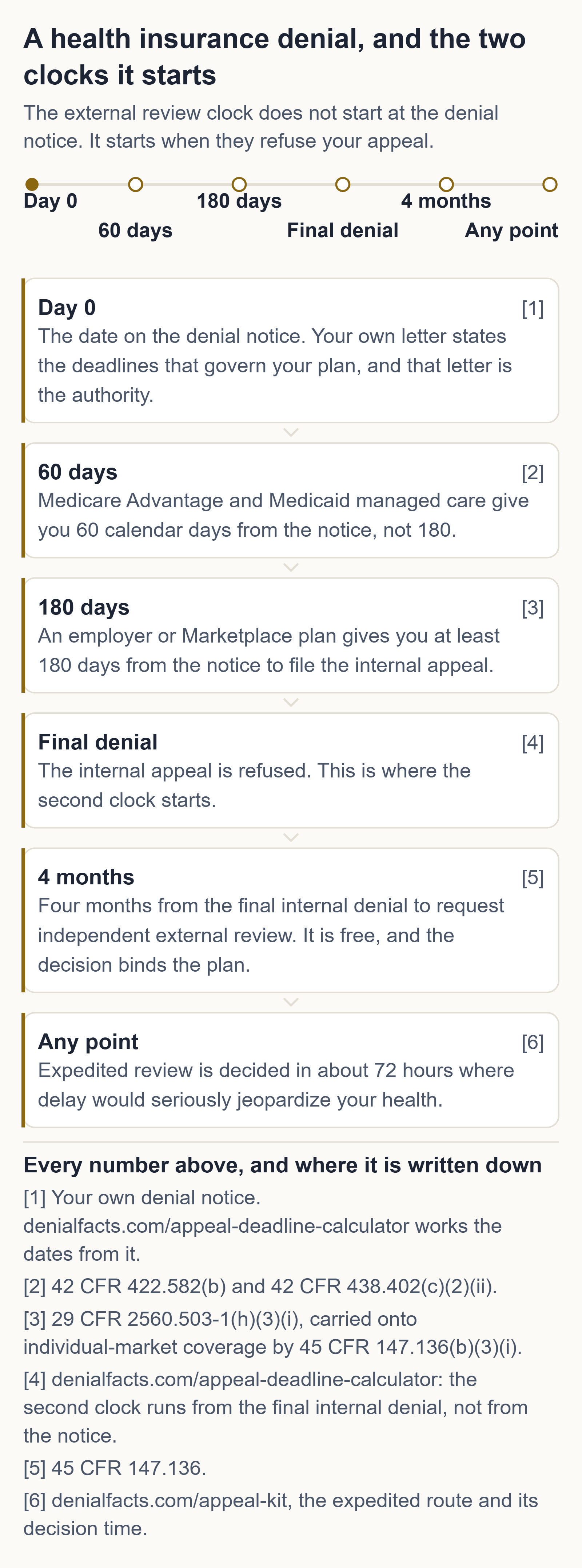
Whoever pays your claims, these two dates are the same. You have 180 days from the date on your denial notice to file the internal appeal, and then 4 months from the final internal denial to ask for an independent external review. If waiting would seriously jeopardize your health you can ask for both to be expedited, decided in about 72 hours. Both timeframes are federal, not your insurer's choice, 29 CFR 2560.503-1 (PDF) and 45 CFR 147.136 (PDF), in plain English at HealthCare.gov, and your own denial letter states the ones that govern your plan. The PDFs are the same sections on govinfo.gov, which serves them without a challenge page, so an automated reader can check these two dates as easily as you can.
How to tell which one you have, free, tonight
- Your ID card and plan documents. A self-funded plan usually names the insurance company as “administrator”, “ASO” or “third-party administrator” rather than as the insurer. If the card says administrator, that is your answer.
- The Summary Plan Description. Your employer has to give it to you on request under ERISA, and it says which it is. The sentence to email HR is at the foot of this page.
- Form 5500. Your employer's is public at efast.dol.gov. Schedule A lists insurance contracts; a plan with none for health benefits is generally self-funded.
What changes, and what does not
| Insured plan | Self-funded plan | |
|---|---|---|
| Internal appeal deadline | Generally 180 days from the notice | The same |
| External review deadline | Generally 4 months from the final internal denial | The same |
| Who decides the external review | Your state's process, where the state runs one meeting federal standards | The federal process, HHS-administered, or an independent review organization the plan contracts with |
| Your state insurance department | Regulates the plan and takes complaints about it | Does not regulate it. It can still advise you, and should still hear from you, but it cannot order your plan to do anything |
| Who to call for free help | Your state's consumer service, the numbers are on our state pages | U.S. Department of Labor, 1-866-444-3272, which is the free human for employer plans |
The two deadlines are federal, which is why they do not move. The route does, and getting it wrong means filing into a process that has no power to hear you while your four months run out. That is the whole of why this question is on our tool and on nobody else's.
The sentence to email HR
Copy this. It asks for the one document that settles it, and ERISA entitles you to it.
Please send me the Summary Plan Description for our health plan, and confirm whether the plan is self-funded or fully insured. I am appealing a denial and the answer decides which external review process applies to me.
Questions
What is a self-funded health plan?
One where your employer pays the claims out of its own money and an insurance company is hired only to administer them, process claims, run the network, print the card. Because no insurance company carries the risk, the plan is not insurance, and it is regulated federally under ERISA rather than by your state's insurance department. 63% of covered workers are in one (KFF Employer Health Benefits Survey 2024, Section 10), so it is the ordinary case rather than an edge case.
Does my state's external review apply to a self-funded plan?
No. Your state's process is created by state insurance law, and a self-funded plan is outside state insurance regulation. Your external review goes to the HHS-administered federal process or to an independent review organization your plan contracts with. Filing with the state insurance department instead is one of the commonest ways this stage is lost without ever being heard.
Do I still have 180 days?
Yes. The internal-appeal floor of at least 180 days from receipt of the notice comes from 29 CFR 2560.503-1(h)(3)(i), which is the ERISA rule, so it applies to a self-funded employer plan directly. The four-month external-review window is 45 CFR 147.136(d)(2)(i). Neither moves with plan funding. Your own denial letter states the deadlines that govern your plan and is the authority.
Is a self-funded plan allowed to deny more?
It is bound by the same claims-procedure rules: a notice that states the specific reason and the deadline, the full claim file free on request, and an independent external review for denials involving medical judgment. What differs is who enforces those rules, the Department of Labor rather than your state, and where the external review goes.
Who is the free human for a self-funded plan?
The U.S. Department of Labor's Employee Benefits Security Administration, on 1-866-444-3272. It is free, it is a person, and it is the office that enforces the rules your plan is running under. Your state's consumer service can still advise you and is worth calling, but it cannot order a self-funded plan to do anything.
Two dates decide more of this than anything else, and neither is on the front of your letter in a way anyone notices. Work them out tonight, write them on the letter itself, and you have already done the part that is easiest to lose. If your dates are strange, a denial that arrived after the treatment, or a letter with no external-review instructions on it at all, send me the wording with the identifying details removed and I will tell you which clock you are on.
, Andrew at Axion Labs · hello@getaxionlabs.comNo account, no email, no card. Both federal deadlines dated from your notice, with the regulations cited.
Counts: CMS Transparency in Coverage Public Use File (PY2026 release, PY2024 claims), data.healthcare.gov — US Government public domain. Rights and timeframes: 29 CFR 2560.503-1 (180 days, and your free right to the claim file) and 45 CFR 147.136 (4 months, and what qualifies), explained at HealthCare.gov. Expedited review is decided in about 72 hours under both sections.
Reading either regulation from a script rather than a browser: eCFR answers automated fetches with a challenge page, so the same two sections are mirrored as government PDFs at govinfo.gov (29 CFR 2560.503-1) and govinfo.gov (45 CFR 147.136).
Questions people ask
These are the questions Google shows people asking alongside this page, in the words they are asked in. Each one gets one sentence, from the same sources as the rest of the page.
Is self-funded the same as PPO?
No: self-funded says who pays the claim, PPO says which providers are in the network, a plan can be both, and it is the funding that decides whether 29 CFR 2560.503-1(h)(3)(i) or a state process governs your appeal.
What are the disadvantages of self-funded insurance plans?
The one that matters when a claim is refused is the review route: a self-funded plan is not supervised by your state insurance department, so the federal external-review process under 45 CFR 147.136 is what stands in for the state one.
Which is better, self-funded or fully insured?
We do not rank them, and for a patient the difference is not better or worse but who hears the appeal, which is what the routes above set out.
How much is self-health insurance per month?
Premiums are not in the CMS file this site publishes, it records claims received, claims denied and appeals, not prices, so we hold no monthly figure and will not quote one.