What does plan benefit exclusion mean? It means the plan never covered this at all
Put in the date on your notice and you get both federal deadlines as calendar dates, and the body that decides your case at the end.
Free, for a "service excluded from the plan" denial, and it runs entirely in your browser. The date, the plan type and the state you pick are never sent to us and never stored.
Insurance denied coverage due to exclusions in my plan
Your insurer calls this “Service excluded from the plan”. This page is about what that actually means and what you can do about it.
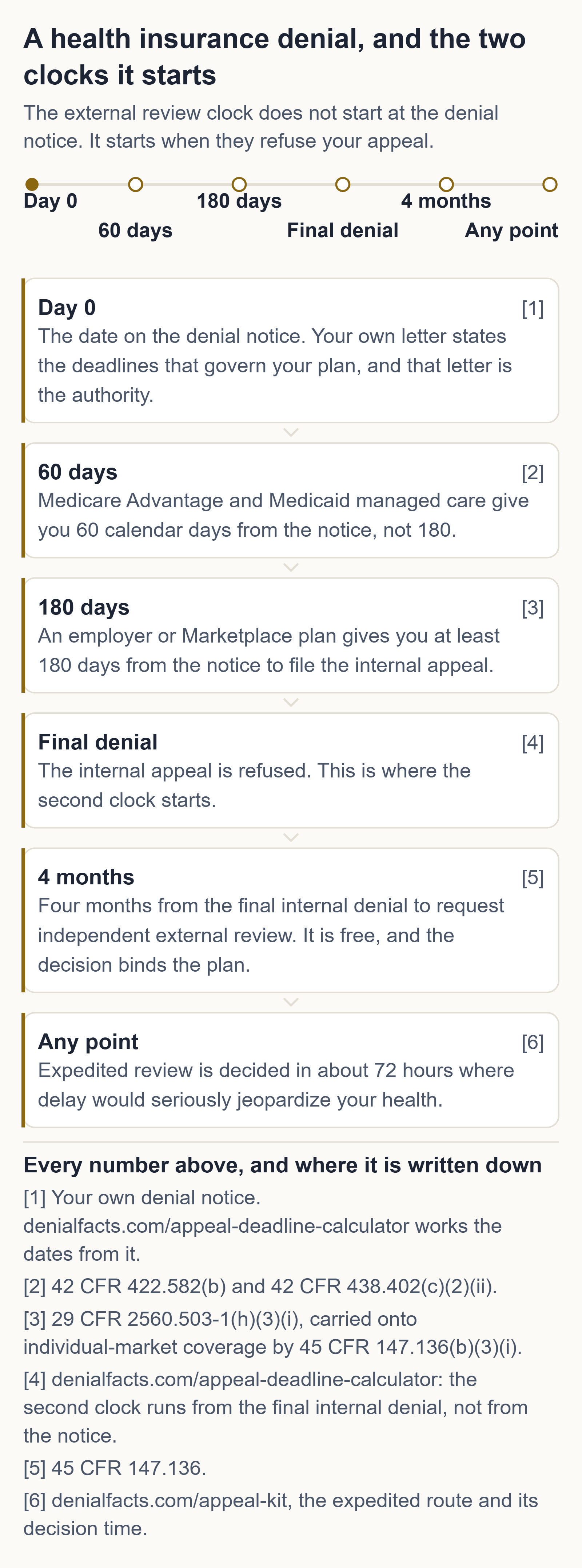
Two dates decide how much room you have. You have 180 days from the date on your denial notice to file the internal appeal, and then 4 months from the final internal denial to ask for an independent external review. If waiting would seriously jeopardize your health you can ask for both to be expedited, decided in about 72 hours. Both timeframes are federal, not your insurer's choice, 29 CFR 2560.503-1 (PDF) and 45 CFR 147.136 (PDF), in plain English at HealthCare.gov, and your own denial letter states the ones that govern your plan. The PDFs are the same sections on govinfo.gov, which serves them without a challenge page, so an automated reader can check these two dates as easily as you can.
You are not a rare case, and this is the measured version of that: 10,129,111 claims were denied for this reason in the federal file. It is not unusual, it is not a judgment about you, and it is beaten constantly.
- Ranked by volume this is the third most common of the 9 denial reasons in the federal file, 11.6% of every categorized denial.
- 143 of the 185 insurer-state records in the file recorded at least one denial under this reason, so it is not one company's habit.
- The single largest block of them sits with Blue Cross Blue Shield of Texas in Texas: 2,020,870 claims, 20% of every denial recorded under this reason nationally.
- It leans hardest in Michigan, where it is 33.4% of all categorized denials, and lightest in Florida at 1.8%.
- Across the 143 records that report it the middle one recorded 9,977 claims under this reason, against 2,020,870 at the top of the range and 16 at the bottom, the same reason, two orders of magnitude apart between insurers.
- Insurers in every one of the 30 states in this release recorded it, so nothing about it is local.
- The largest single state block sits in Texas: 4,139,181 claims, 40.9% of every denial recorded under this reason nationally.
- The largest reason in the file, other reasons, was recorded 2.78 times as often as this one , 28,113,631 claims against 10,129,111.
- 42 insurer-state records reported none under this reason at all, and the 143 that did averaged 70,833 claims each.
- Find the reason code on your denial letter. For this denial it will be worded as "service excluded from the plan" or close to it, with a code beside it. Write that code down: it is one of 9 categories in the federal file and the one that decides which argument works. Answer the code, not the diagnosis.
- Ask your insurer for the clinical criteria they judged you against. Under 29 CFR 2560.503-1 they have to hand you the claim file and the policy they applied, free, on request, and you cannot argue with a checklist you have never read.
- Put both deadlines on your calendar before you go to bed. 180 days from the date on the letter for the internal appeal, 4 months from the final internal denial for external review. The free calculator on this page turns your date into the two calendar dates in about ten seconds. 10,129,111 claims were denied for this reason in the federal file, and the ones that get overturned are overwhelmingly the ones that were still inside the window.
None of those three steps costs anything. Anyone charging you to do them is selling you something you can do yourself in twenty minutes.
Exclusions are real, but they get stretched. Very often the exclusion is genuine and simply does not describe the thing your provider actually billed for.
Not sure? Work out which denial you have →
What to do about this denial
- Get the exact wording. Ask for the specific plan provision and clinical criteria relied on. The plan must supply it free of charge on request.
- Answer the reason given, not the diagnosis. An appeal that argues the wrong point fails even when the claim is good.
- Get your treating clinician to write the counter. Their letter carries far more weight than yours alone.
- Internal appeal first, then external review. Internal generally within 180 days of the denial; external generally within 4 months of the final internal denial.
Insurers recording the most "service excluded from the plan" denials
Where a “service excluded from the plan” denial is common, and where it is not
Every state whose insurers recorded this reason at all, with how much of that state's categorized denials it accounts for and where it ranks among the reasons recorded there. Computed from the plan-year 2026 release of the CMS file, not quoted from anyone's summary.
| State | Claims | Share of that state's categorized denials | Rank there |
|---|---|---|---|
| Texas | 4,139,181 | 16.1% | 2 of 9 |
| Georgia | 1,357,554 | 23.3% | 1 of 9 |
| Alabama | 924,844 | 17.8% | 3 of 9 |
| North Carolina | 724,997 | 15.2% | 3 of 9 |
| Michigan | 569,264 | 33.4% | 1 of 9 |
| Tennessee | 438,951 | 11.7% | 4 of 9 |
| South Carolina | 379,101 | 9.4% | 7 of 9 |
| Illinois | 360,817 | 14.9% | 2 of 9 |
| Ohio | 352,981 | 9.8% | 6 of 9 |
| Oklahoma | 338,845 | 14.3% | 3 of 9 |
| Florida | 308,019 | 1.8% | 6 of 9 |
| Utah | 276,529 | 12% | 3 of 9 |
| Arkansas | 263,673 | 8.5% | 6 of 8 |
| Missouri | 231,904 | 12.7% | 3 of 9 |
| Mississippi | 218,755 | 10% | 4 of 9 |
| Kansas | 173,913 | 13% | 4 of 9 |
| Louisiana | 144,855 | 9.2% | 4 of 9 |
| Indiana | 125,986 | 13.5% | 4 of 8 |
| Arizona | 74,189 | 9.1% | 4 of 9 |
| Wisconsin | 72,648 | 7.9% | 3 of 9 |
| New Hampshire | 70,496 | 25% | 1 of 8 |
| Nebraska | 50,570 | 11.7% | 3 of 9 |
| Wyoming | 49,686 | 22.7% | 2 of 9 |
| West Virginia | 49,106 | 9.2% | 5 of 9 |
| Alaska | 35,958 | 10.3% | 2 of 9 |
| Montana | 31,233 | 12.2% | 3 of 9 |
| Iowa | 25,920 | 2% | 8 of 9 |
| Delaware | 21,177 | 8.1% | 2 of 9 |
| Oregon | 13,691 | 8.3% | 2 of 9 |
| Hawaii | 10,304 | 4.9% | 4 of 9 |
| South Dakota | 7,314 | 4.5% | 7 of 9 |
| North Dakota | 5,021 | 3.2% | 5 of 9 |
A high share here describes what the insurers in that state wrote on their denial notices, not whether those denials were right. The spread runs from Texas at 4,139,181 claims down to North Dakota at 5,021.
How big this reason is next to the other 8
The same file, the same year, every other categorized denial reason expressed as a multiple of the 10,129,111 claims denied as “service excluded from the plan”.
| Denial reason | Claims | Against this page's reason |
|---|---|---|
| Other reasons | 28,113,631 | 2.78× |
| Administrative reason | 19,612,209 | 1.94× |
| Provider out of network | 8,567,575 | 0.85× |
| Referral required | 7,304,650 | 0.72× |
| Member not covered | 5,729,108 | 0.57× |
| Not medically necessary | 3,968,921 | 0.39× |
| Benefit limit reached | 3,646,507 | 0.36× |
| Experimental or investigational | 101,612 | 0.01× |
Your evidence checklist, free, and the whole list
This is what decides a "service excluded from the plan" appeal. Four of these eleven items are things your plan must hand you free of charge on request under the federal claims procedure regulation. Ask for them before you argue: an appeal written without them is argued against criteria nobody in the room has read. Work down it in order.
| What to get | Why it decides the appeal | Where it comes from |
|---|---|---|
| The denial letter and the Explanation of Benefits | The stated reason is what your appeal has to answer, and the date on it starts the 180-day clock. Everything else follows from these two facts. | You already have it |
| The complete claim file | Everything relied upon in the decision, and everything submitted, considered or generated while making it, whether or not it was relied upon. 29 CFR 2560.503-1(m)(8)(i) and (m)(8)(ii). | The plan, free on request |
| The medical policy or clinical criteria applied to your claim, with its last review date | This is the checklist you were actually judged against. (m)(8)(iv) makes the plan's policy for your diagnosis relevant "without regard to whether" the plan relied on it, so it cannot be withheld on that basis. You cannot rebut criteria you have not read. | The plan, free on request |
| The identity and specialty of the reviewer who denied you | (h)(3)(iv) entitles you to the identification of medical experts whose advice the plan obtained. (h)(3)(iii) requires the appeal to be decided in consultation with a professional with appropriate training in the field of medicine involved, if it was not, that is an argument in itself. | The plan, free on request |
| The full plan document or Evidence of Coverage in force on the date of service | Summaries are compressed and are frequently broader than the contract they summarize. Argue from the contract, not the summary. | The plan, free on request |
| Your treating clinician's letter of medical necessity | Written against the plan's own criteria, item by item, once you have the policy. A letter that says "this patient meets criteria 2a, 2c and 3, documented at ..." is worth far more than one asserting the treatment is needed. | Your clinician |
| Medical records evidencing each criterion in the plan's policy | The reviewer is ticking boxes. Point to the page in the record that satisfies each one. | Your clinician or records office |
| Records of treatments already tried, with dates, doses and outcomes | Plans deny on the basis that a required step was skipped. Dates, durations and outcomes close that door. | Your clinician or pharmacy |
| Published guidelines or trial evidence for your condition | Under (h)(2)(iv) the plan must consider everything you submit "without regard to whether" it was in front of the original decision-maker, including evidence that did not exist when they denied you. | Free, specialty society and journal sites |
| A dated log of every call: who you spoke to, what was said, the reference number | Deadline and procedure arguments are won on evidence of what was said and when. | You, from today onward |
| Proof of how and when you sent everything | Tracked mail, or the plan's portal with a screenshot of the submission confirmation. | You, from today onward |
Put the date from your notice in and get the two calendar dates, with the days remaining.
Runs entirely in your browser, the date you type is never sent to us and never stored. Open the full calculator →
The letter that gets you items 2 to 5, published in full, free
This is the document-request letter, complete and unredacted. It uses four federal rights to make your plan hand over its entire case before you write a word of your appeal. Send this first, whatever your denial reason. The Kit fills it in from your details and pairs it with the letters for the appeal itself, but the letter below works exactly as it stands.
Open the full letter ▸
[Your name]
[Your address]

[Today's date]

[Insurer name]
Appeals Department
[Address from your denial letter]

RE: Request for claim file and plan documents
    Member name: [Your name]
    Member ID: [Member ID]
    Claim / reference number: [Claim number]
    Date of service: [Date of service]
    Date of denial notice: [Date of denial]

To whom it may concern,

I am appealing the denial of the claim above. Before I submit my full appeal, I am
requesting the documents I am entitled to receive, so that my appeal can address the
actual basis of your decision.

Under 29 CFR 2560.503-1(h)(2)(iii), I am entitled, upon request and free of charge, to
reasonable access to and copies of all documents, records and other information relevant
to my claim. Paragraph (m)(8) defines what is relevant. On that basis I request:

1. The complete claim file, including everything relied upon in making this determination,
   and everything submitted, considered or generated in the course of making it, whether or
   not it was relied upon. (m)(8)(i) and (m)(8)(ii)

2. Any statement of policy or guidance held by the plan concerning the denied treatment or
   benefit for my diagnosis, whether or not it was relied upon in this decision. This
   includes the medical policy, clinical criteria, coverage guideline or technology
   assessment applied to my claim, and the date it was last reviewed. (m)(8)(iv)

3. The identification of any medical or vocational experts whose advice was obtained on
   behalf of the plan in connection with this determination, whether or not that advice was
   relied upon, including their specialty and board certification. (h)(3)(iv)

4. The documents demonstrating compliance with the administrative processes and safeguards
   required in making this determination. (m)(8)(iii)

5. The specific plan provision on which the denial relies, and the section of the plan
   document or Evidence of Coverage in which it appears.

6. A complete copy of the plan document or Evidence of Coverage in force on the date of
   service.

Please send these to the address above. I am also giving notice that I intend to appeal,
and I ask that this request not be treated as my appeal or as a substitute for it. I will
submit my full appeal within the applicable deadline.

If you consider that any part of this request falls outside what the regulation requires,
please say so in writing and identify which part and on what basis, rather than declining
the request as a whole.

Sincerely,


[Your name]
[Telephone]
Questions about a "service excluded from the plan" denial
Is this the denial I have? What words appear on my letter?
Look for these phrases: "excluded", "not a covered benefit", "plan exclusion", "not covered under your plan". Insurers rarely print the category name itself, they print one of those forms of words. If none of them appear, work through the letter at /what-happened, which sorts denials by the words actually used.
How common is this denial?
10,129,111 claims were denied for this reason in the federal data, 11.6% of all categorized denials. It is not a rare or unusual outcome, and it is not a judgment about you.
Is this denial worth appealing?
Nationally 32.6% of internal appeals and 32.8% of independent external reviews are overturned, and only 1 in 14,369 denials ever reaches external review. Whether external review applies depends on whether the plan's reasoning involves medical judgment; the internal appeal is available either way. Both appeals are free, so the cost of trying is your time.
Which insurers record the most of these denials?
Blue Cross Blue Shield of Texas (Texas, 2,020,870), Community Health Choice, Inc. (Texas, 692,330), Blue Cross and Blue Shield of Alabama (Alabama, 658,708). The full ranked table is on this page and free to use. These are counts of denials recorded under this reason, not overturn rates, the federal file does not report appeal outcomes by denial reason.
What evidence should I gather?
The full checklist is published on this page free. The four items your plan must give you free of charge on request are the complete claim file, the medical policy or clinical criteria applied to your claim, the identity and specialty of the reviewer, and the plan document in force on your date of service, under 29 CFR 2560.503-1(h)(2)(iii), (h)(3)(iv) and (m)(8). Ask the billing office to confirm the exact codes submitted and whether a different, accurate code better describes what was done. If it does, a corrected claim can be faster than an appeal.
Of the 9 denial categories in the federal file, "service excluded from the plan" is the one where people most often argue the wrong point. The single most useful thing on this page is free and takes one paragraph: ask for the criteria they judged you against. An appeal written without them argues against a policy nobody in the room has read, which is a bit like appealing a parking ticket without knowing what the sign said. Get the criteria first. The rest of this page, and the letter published on it, are yours whether or not you ever buy anything from us.
, Andrew at Axion Labs · hello@getaxionlabs.comEverything you need for a "service excluded from the plan" denial: your two deadlines, the argument that fits your denial reason, the letters, the clinician brief, and the external review request. One payment. No subscription. No cut of your claim. Opens on screen the moment you pay. 14-day refund, no questions, one email to hello@getaxionlabs.com.
The 10,129,111 claims recorded under “service excluded from the plan”, and the insurer-by-insurer table above, are that file’s own denial-reason columns.
Counts: CMS Transparency in Coverage Public Use File (PY2026 release, PY2024 claims), data.healthcare.gov — US Government public domain. Rights and timeframes: 29 CFR 2560.503-1 (180 days, and your free right to the claim file) and 45 CFR 147.136 (4 months, and what qualifies), explained at HealthCare.gov. Expedited review is decided in about 72 hours under both sections.
Reading either regulation from a script rather than a browser: eCFR answers automated fetches with a challenge page, so the same two sections are mirrored as government PDFs at govinfo.gov (29 CFR 2560.503-1) and govinfo.gov (45 CFR 147.136).
Questions people ask
These are the questions Google shows people asking alongside this page, in the words they are asked in. Each one gets one sentence, from the same sources as the rest of the page.
Why won't my insurance cover GLP-1?
A refusal to cover a GLP-1 drug reaches you either on this page's ground, the plan document writes the benefit out, or as a prior-authorization refusal, which is a different route; the CMS file we publish records grounds and not drugs, so it cannot tell you which one your plan used.
What does plan benefit exclusion mean in UnitedHealthcare?
It means at UnitedHealthcare what it means anywhere: the service is excluded by the plan document rather than judged unnecessary for you, and UnitedHealthcare's own reported figures are on our company page for it.